

Your House Is Already Maxed Out: The Honest Guide to Electrical Panel Upgrades in Indianapolis and Chicago
Your House Was Wired for a Toaster and a Table Lamp

Picture the original owner of your house. It's 1974. He's got a black-and-white TV, a window AC unit he runs three months a year, and a kitchen appliance lineup that tops out at a percolator and a hair dryer. That's what your electrical panel was sized for.
Now you're sitting in that same house with two home offices, a heat pump, a chest freezer in the garage, and teenagers who need three screens each to do homework. Maybe you just bought an EV. The infrastructure hasn't changed. The demand has roughly tripled.
This isn't a problem unique to you. Nearly half — about 48%, per the National Association of Home Builders — of all owner-occupied homes in the U.S. were built before 1980. Chicago's housing stock skews even older — roughly 46% of homes predate 1940. Indianapolis neighborhoods like Broad Ripple, Irvington, and the Southside are packed with ranches and split-levels from the 1950s through '70s. Beautiful homes. Panels that are exhausted.
The good news: an electrical panel upgrade is a solved problem. It takes about a day. It costs real money — we'll give you actual numbers right up front, not a "call for a quote" runaround — and when it's done, your house is ready for the next fifty years instead of already behind by thirty. Here's what you need to know.
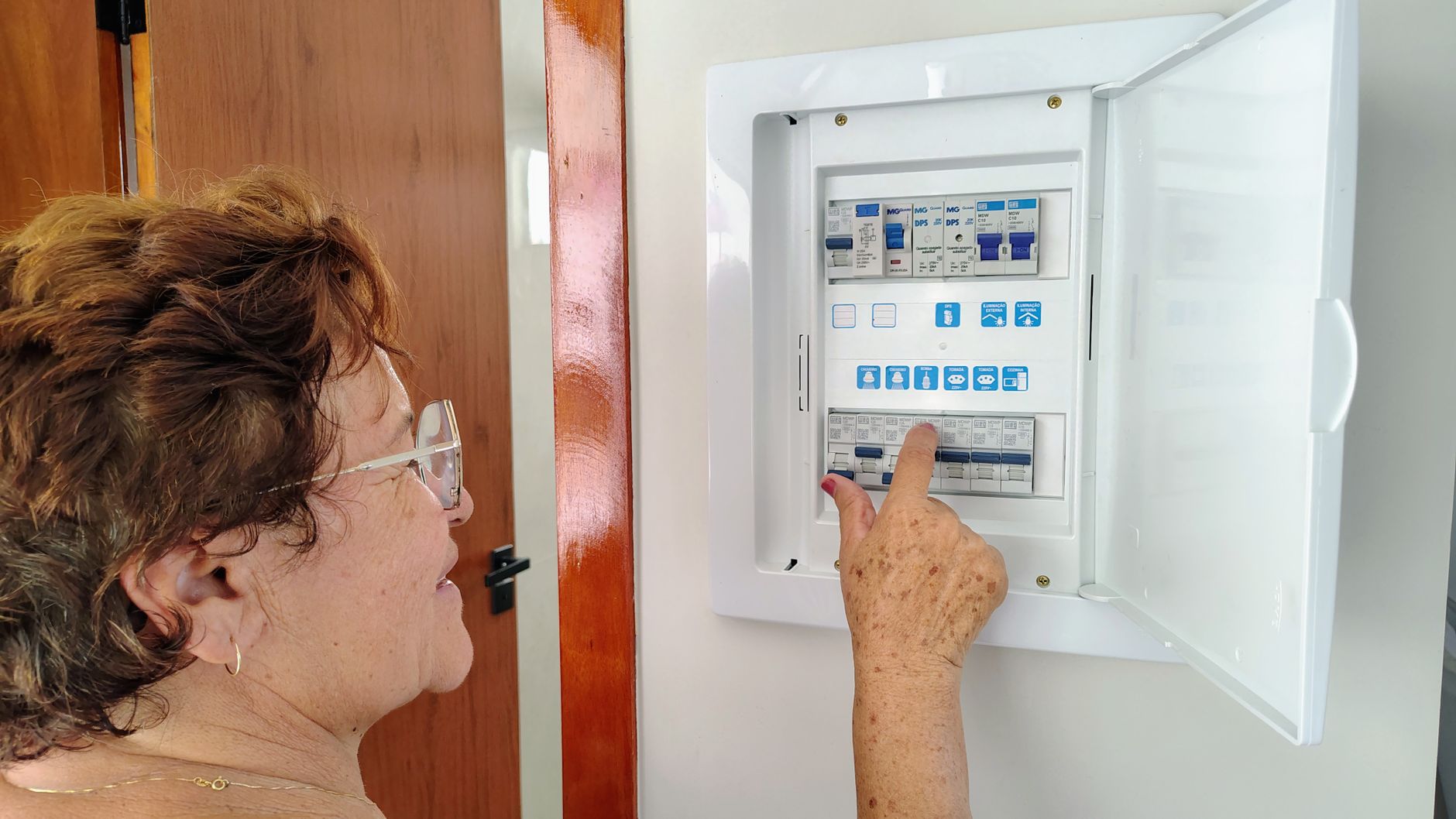
What "Upgrading Your Panel" Actually Means
Your electrical panel — also called a breaker box or service panel — is the gray metal box on your basement wall. It's where power coming in from the utility line gets divided up and sent to every circuit in the house. Each breaker protects one circuit: when too much current flows through, the breaker trips before something catches fire.
When electricians talk about upgrading a panel, they mean one or both of these things:
- Increasing amperage — replacing a 100-amp or 150-amp panel with a 200-amp (or larger) unit so the house can handle more total load
- Replacing a failed or dangerous panel — swapping out a brand known to malfunction, or a panel that's simply run its course
A 100-amp panel was adequate for a mid-century home with gas heat and basic appliances. A 200-amp panel is today's standard for most single-family homes. Larger homes with multiple HVAC zones, EV chargers, or home workshops often need 400 amps. The actual install involves disconnecting the utility feed, pulling the old panel, putting in the new one, and passing a final inspection. Your power will be off for most of the day. Plan around it.
The Warning Signs Your Panel Is Already Crying for Help

What's behind your panel cover: circuit breakers, bus bars, and bundled circuits. This complexity is exactly why panel work requires a licensed electrician — not a YouTube video. (Wikimedia Commons, GFDL/CC BY-SA)
Some of these you've probably noticed and filed under "that's just how the house is." That's not a character flaw — it just means nobody told you it wasn't normal.
- Breakers trip constantly — Running a microwave and a hair dryer simultaneously shouldn't be a negotiation. If it is, your panel is telling you something.
- Lights flicker or dim when appliances kick on — The fridge compressor starts and the kitchen dims. That voltage sag is your panel struggling.
- You still have a fuse box — Installed before roughly 1965. Fuses work, but homeowners swapping in oversized fuses to stop nuisance trips removes the protection entirely. Replace it.
- You have a Federal Pacific Electric (Stab-Lok) or Zinsco panel — Read the next section immediately. These aren't ordinary aging panels.
- Your home runs on 60-amp or 100-amp service — 60-amp is genuinely inadequate for any modern household. 100-amp is marginal the moment you add a heat pump or an EV charger.
- You smell burning near the panel, or the box is warm — Not a "wait and see." Call an electrician today.
- The panel is full — No room for new breakers; circuits are doubled up with tandem breakers crammed into slots not designed for them.
- Your panel is 25–40+ years old — That's the expected lifespan. A 1980s panel in a 1980s house is right at the line.
- Your insurance company is asking questions — Or has already sent a notice. More on that next.
The Usual Suspects: Federal Pacific and Zinsco Panels
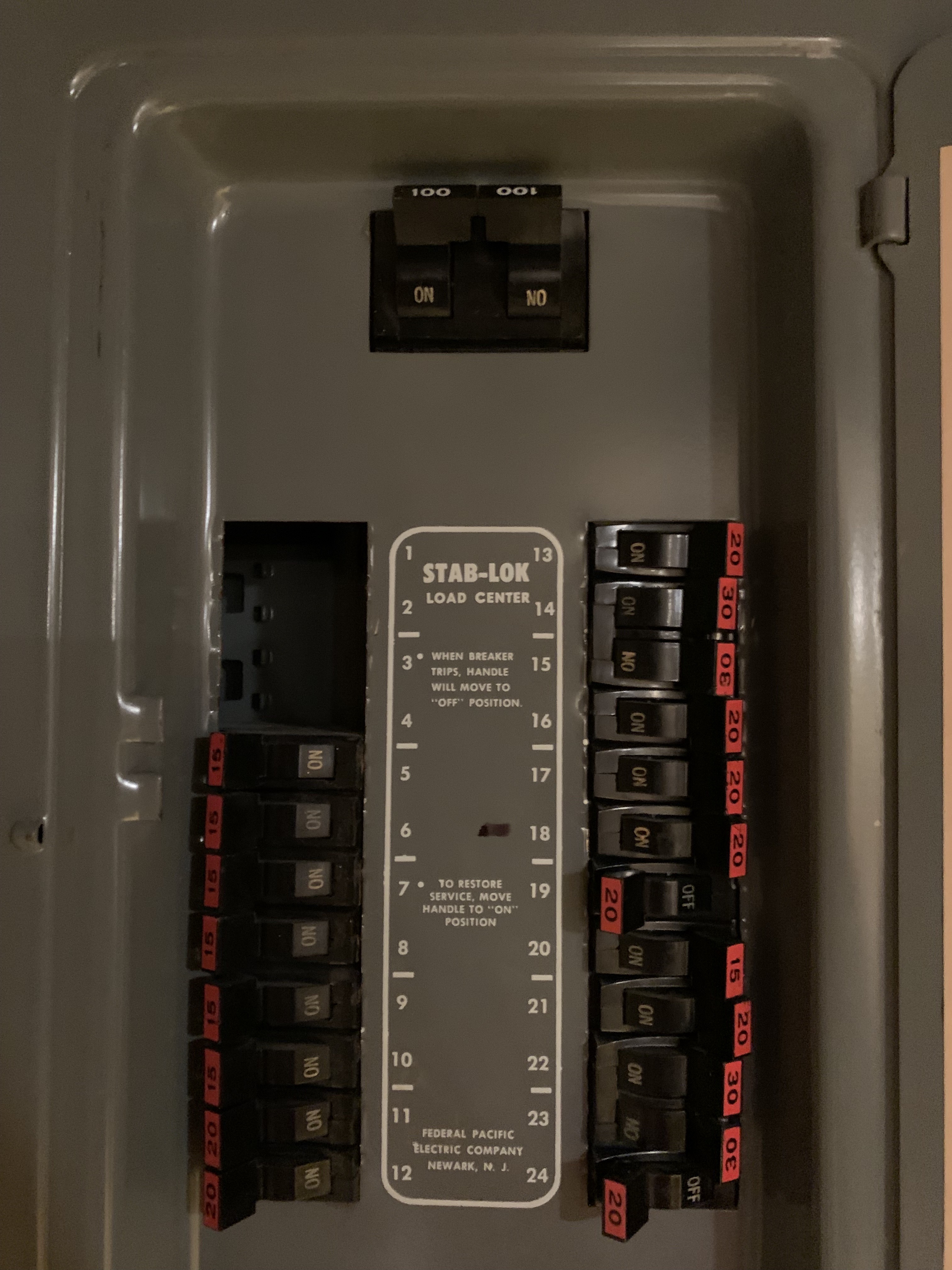
A Federal Pacific Electric Stab-Lok load center. If your panel says "STAB-LOK LOAD CENTER" and "FEDERAL PACIFIC ELECTRIC COMPANY" — you've found your answer. (Photo: Repeater-reclaim, CC BY-SA 4.0)
If you open your panel and see Federal Pacific Electric or Stab-Lok on the breakers, or if the brand reads Zinsco (sometimes sold as GTE-Sylvania), this section is for you.
These panels were installed by the millions in American homes from the 1950s through the '80s, and they're extremely common in Midwest housing stock. The problem isn't age — it's that they're known to fail at the one job a breaker has: tripping under overload. Federal Pacific's Stab-Lok breakers have been linked to fires from breakers that didn't trip when they should have. Zinsco's bus bars corrode and overheat, and in some cases the breakers fuse to the panel and can't be switched off manually.
Here's the part nobody puts in the home improvement articles: most major insurance carriers may refuse to write a new policy — or cancel an existing one — if they discover an FPE or Zinsco panel. This isn't buried in fine print. There are documented cases of homeowners receiving 30-day notices: replace the panel or lose coverage *(per homeowner accounts)*. If you're selling, a buyer's inspector will flag it immediately, and buyers will either leverage it hard or walk.
If you have one of these panels, the only question is when to replace it — not whether.
Why Your EV Is the Straw That Broke the Panel's Back
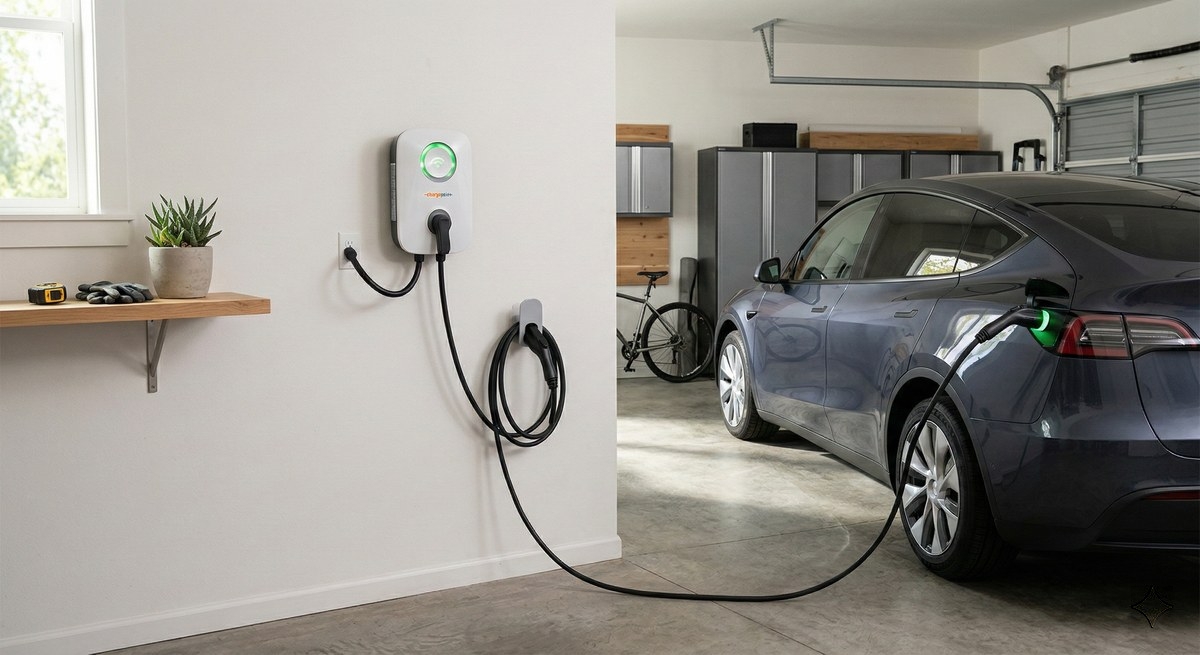
A Level 2 home EV charger — the kind that requires a dedicated 240V circuit and often triggers a panel upgrade. Most older homes simply don't have the spare capacity.
The little 120V brick that came with your EV adds about 4–5 miles of range per hour. It'll technically charge the car — slowly, overnight, with a prayer. A real Level 2 home charger — the kind that adds 25–30 miles of range per hour — needs a dedicated 240V circuit with at least a 50-amp breaker. For maximum charging speed, you're looking at an 80-amp charger that wants a 100-amp breaker on that circuit alone.
Here's the math problem: according to Qmerit, one of the largest EV charger installation networks in the country, more than 50% of American homes run on 100-amp service or less (September 2025). That means more than half of us live in houses where the EV charger alone could theoretically consume the entire electrical capacity of the building.
Add a charger to a 1970s home with 100-amp service, a heat pump, an electric range, and two home offices, and your electrician will run a load calculation and tell you exactly this. The solution in most cases is a 200-amp upgrade before or alongside the charger install. Either way, the panel comes first.

What It Actually Costs in Indianapolis and Chicago
Real numbers, not ranges so wide they're useless.
| Panel Size | Indianapolis (Installed) | Chicago (Installed) |
|---|---|---|
| 100-amp upgrade | $800–$1,000 | $1,500–$2,500 |
| 150-amp upgrade | $1,000–$1,400 | $2,000–$3,500 |
| 200-amp upgrade | ~$1,162 avg ($448–$1,932) | $1,300–$2,000 |
| 400-amp upgrade | $2,500–$4,000+ | $5,000+ |
Sources: Angi (Marion County, Aug 2025), Manta (Indianapolis 2025), Mr. Mighty Electric (Chicago, Oct 2025), Homewyse (Jan 2026).
Chicago's overall average lands around $1,400 (Mr. Mighty Electric, Oct 2025), pushed above the national baseline by higher labor rates and the ComEd coordination requirement. Indianapolis benefits from lower labor rates than the Chicago metro, where licensed electricians run $50–$150 per hour and a full panel job involves 20–30+ hours across the crew. The national baseline from Homewyse (January 2026) sits at $1,325–$1,606 for a standard mid-range install.
What pushes the final number higher:
- Panel relocation — Moving to a different wall: $1,500–$4,000
- Old wiring replacement — Aluminum, knob-and-tube, or heavily degraded wiring found during the job: $600–$4,500
- AFCI/GFCI breaker upgrades — Required under NEC 2020; usually factored into a full upgrade quote
- Permit fees — Cook County: $50–$300; Indiana varies by jurisdiction
If a contractor quotes you $400 and says you don't need a permit, that's not a deal. That's a problem.

Permits, Inspections, and Indiana Code — The Paperwork Nobody Loves But Everyone Needs
Indiana follows NEC 2020 with state-specific amendments. One thing most homeowners don't know: in Indiana, local jurisdictions cannot adopt their own electrical code unless approved by the Indiana Fire Prevention and Building Safety Commission. The state sets the rules, not the city — so whether you're in Indianapolis, Carmel, or Greenwood, you're working to the same standard.
In Chicago and Cook County, permit fees run $50–$300 depending on scope. Permit processing in Indiana is typically 1–5 business days for simple residential work, though Indianapolis can run 2–4 weeks for larger jobs.
Who pulls the permit? Your electrician does. It's part of the job, not an extra. If a contractor says you don't need a permit for a panel upgrade, find a different contractor. A permit gets you an inspection, an inspection confirms the work is safe, and that documented pass protects you at resale.
Under NEC 2020, a panel upgrade typically triggers requirements for AFCI breakers in living areas and bedrooms, expanded GFCI protection in kitchens, bathrooms, garages, and outdoor circuits, and a minimum 3 feet of clear working space in front of the panel. These aren't bureaucratic hoops — they're the specific things that prevent house fires. Pass the inspection and you have documented proof your electrical system is current code. That's worth something.

Why Spring Is the Smart Window — Not Just Marketing
Yes, every home services company says "call in spring." Here's why it's specifically true for electrical panel work:
Electrician availability collapses in summer. Starting around June, contractors in Indianapolis and Chicago get hammered with AC service calls and heat-season emergencies. The two-week scheduling window in March becomes a six-week queue in July. If you want a crew that isn't rushed and a timeline you can plan around, spring is genuinely the window.
A panel upgrade removes an inspection red flag before your home hits the market. If you're listing this spring or summer, an outdated panel will show up on the buyer's inspection report as a negotiating chip — or a financing condition. FHA and VA loans have specific electrical safety requirements. Getting the panel done in March means it's a non-issue when buyers walk through.
You'll test the new system before you need it. A panel upgrade done in spring gets a real-world stress test during summer peak demand. Better to surface any remaining issues in May than in August when every electrician in the city is already booked.
If you're adding an EV charger, do it before driving season. Buying an EV in April and spending the summer trickle-charging it because the panel upgrade slipped to August is a particular kind of frustrating. Spring closes that gap.

What to Expect From Start to Finish
Here's what the process actually looks like:
- Initial consultation (1–2 hours on-site): A licensed electrician visits, runs a load calculation, assesses the existing panel, and recommends the right size for your current and anticipated needs. EV charger plans and home office circuits get surfaced here.
- Permit application (same day): Your electrician submits it. You don't do this — they do.
- Permit processing (1–5 business days, up to 2–4 weeks for complex jobs): Equipment procurement happens during this window.
- Installation day (1 full day): Plan to be home. Power is typically off 6–8 hours. Two to three technicians on-site is normal. In Chicago, ComEd handles utility disconnect/reconnect — your electrician coordinates it. In Indianapolis, that's IPL or Duke Energy.
- Final inspection (1–5 business days after install): Inspector verifies code compliance. Pass, and you're done.
- Total timeline: 1–3 weeks start to finish for most residential jobs.
The day of install is the easy part. Eat breakfast before they cut power, plan to work somewhere else for the day, keep pets clear. By evening you'll have a panel that's ready for the next thirty years.

Licensed electricians on a residential panel replacement job. Hi-vis vests, hard hats, circuit directory in hand — this is what a professional crew looks like. Find yours at Saorr.com. (U.S. Fish & Wildlife Service, public domain)
How to Find the Right Electrician (and What Questions to Actually Ask)
The difference between a clean panel upgrade and a headache that follows you into your next home inspection usually comes down to who you hired. Here are the six questions that actually matter:
- "Are you licensed in Indiana / Illinois, and can I verify your license number?" Both states maintain public license lookup tools. A licensed contractor hands you the number without hesitation. An unlicensed one changes the subject.
- "Who pulls the permit — you or me?" The electrician pulls it. If they say otherwise, find someone else.
- "Will you do a load calculation before finalizing the quote?" A proper load calculation factors in your appliances, HVAC, square footage, and planned additions. Without it, panel size is a guess. Don't accept a guess.
- "Is this a fixed-price bid or time-and-materials?" Both are legitimate. Fixed price gives you certainty. T&M can make sense on complex jobs but can grow — if it's T&M, ask for a not-to-exceed number and get it in writing.
- "What would trigger additional costs?" Legitimate answers: discovering knob-and-tube or aluminum wiring, needing to relocate the panel, finding the service entrance cable needs replacement. Vague answers — "we'll see what's in there" — are a yellow flag.
- "How do you handle the utility coordination?" In Chicago, ComEd must disconnect and reconnect service. In Indianapolis, it's IPL or Duke Energy. An experienced contractor handles this routinely; a less experienced one may treat it as your problem.
Get at least two quotes — not to find the cheapest, but to calibrate. A quote that comes in 40% below everyone else isn't a deal. It's a question mark. Check reviews for specifics: "showed up on time, pulled the permit, passed inspection first try" tells you more than five stars and a thumbs-up.
If you're not sure where to find someone worth trusting, Saorr.com connects Indianapolis and Chicago homeowners with licensed, vetted electricians who've been verified and reviewed. Describe the job, get matched with contractors who know what they're doing. No cold calls, no guessing whether someone actually holds a license.
Your house didn't fail you. It just got lapped by the 21st century. That's fixable — and spring is a good time to fix it.
Hero panel / Closed Eaton panel: "Eaton circuit breaker panel closed" by BrokenSphere, CC BY-SA 3.0. https://commons.wikimedia.org/wiki/File:Eaton_circuit_breaker_panel_closed.JPG
Open panel interior: Wikimedia Commons contributor, GFDL/CC BY-SA. https://commons.wikimedia.org/wiki/File:Breakerpanel-level4-inside-view135dl.jpg
Stab-Lok FPE panel: "Stab-Lok circuit breaker panel interior" by Repeater-reclaim, CC BY-SA 4.0. https://commons.wikimedia.org/wiki/File:Stab-Lok_circuit_breaker_panel_interior_.jpg
Contractor photo: U.S. Fish & Wildlife Service – Pacific Region, public domain. https://www.flickr.com/photos/52133016@N08/5857280745
Find Trusted Pros Near You
Ready to start your project? Connect with vetted, top-rated contractors in your area.
Get Started