
Radon Testing & Mitigation: What Indianapolis & Chicago Homeowners Must Know (2026)
Gary's daughter was buying a house in Carmel. The inspector flagged radon at 6.8 pCi/L. Gary's reaction — twenty-year homeowner, guy who'd fixed just about everything in his own ranch house — was a shrug. "That's just something they put in inspection reports to give the buyer leverage," he said. His wife Donna didn't say anything. She just pulled up the EPA's page on radon health risk and slid her phone across the kitchen table.
Radon kills roughly 21,000 Americans every year. That's not a misprint. It's the second-leading cause of lung cancer in this country, behind only cigarettes — and the number-one cause among people who've never smoked a day in their lives. You can't see it. You can't smell it. You can't taste it. It's just there, seeping up from the ground into your basement right now, and you won't know it until you test.
Gary tested. His house came back at 7.2 pCi/L. This is what he learned, and what you need to know too.
What Is Radon — And Why Should Midwest Homeowners Care?
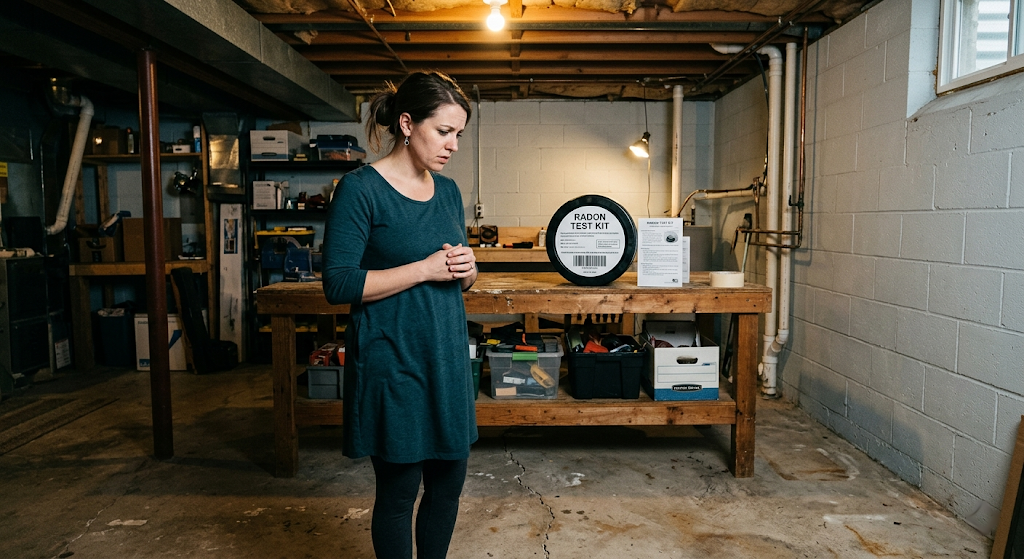
Radon is odorless, colorless, and invisible — most Midwest homeowners have no idea their basement levels are elevated until they test.
Radon is a naturally occurring radioactive gas. It forms from the decay of uranium in soil, rock, and water — the stuff your house is literally sitting on. As that uranium breaks down over millions of years, it produces radium, which breaks down into radon gas. That gas rises through the soil and, if there's a path, into your home.
There's no color. No odor. No taste. Nothing that tells your body it's happening. You breathe it in, and the radioactive particles it carries lodge in your lung tissue. Over years, that leads to cell damage. That cell damage leads to cancer. The EPA estimates 21,000 Americans die from radon-induced lung cancer each year — more than die in drunk driving crashes.
The EPA sets the action level at 4.0 pCi/L (picocuries per liter of air). At that level, your risk of lung cancer from radon exposure over a lifetime is roughly comparable to having 200 chest X-rays per year. The World Health Organization recommends action at even lower levels — 2.7 pCi/L — because the science keeps showing that no level of radon exposure is truly "safe," it's just a question of degree of risk.
If you're a smoker living in a high-radon home, the risk multiplies dramatically — not adds, multiplies. The combination of radon and smoking is substantially more dangerous than either on its own.
The national average indoor radon level is around 1.3 pCi/L. In Indiana, the statewide average is 4.7 pCi/L — already above the action threshold before you even open a door.
The Bad News — Indiana and Illinois Are High-Risk States

Homes like this one in Tipton, Indiana sit on soils with naturally elevated radon potential — the same flat glacial-till geology that covers most of the Midwest. Testing is the only way to know your risk. Photo: Pexels
Let's be direct: if you live in Indiana, you live in a high-radon state. The EPA's radon zone map shows every Indiana county classified as Zone 1 or Zone 2 — meaning every county in the state faces medium-to-high radon potential. Marion County, which contains Indianapolis, is EPA Zone 1: the highest risk category, with average indoor radon levels predicted to exceed 4 pCi/L.
The Indiana State Department of Health estimates nearly 1 in 3 Indiana homes have radon levels above the EPA action threshold. That's not a fringe number — that's your neighborhood. Your street. Possibly your house.
Northern Indiana counties — St. Joseph, Elkhart, Kosciusko — are among the highest-measured in the state. But the reality is that elevated radon has been found in every corner of Indiana. The geology doesn't care about ZIP codes.
Chicago and Cook County get a slightly better draw. Cook County sits in EPA Zone 2, with predicted average levels between 2 and 4 pCi/L. Actual tested averages in Cook County run around 1.7 pCi/L — but averages hide outliers, and plenty of individual homes in the Chicago area test significantly higher, especially those with basements. Chicago bungalows, two-flats, and ranch-house suburbs all sit on ground that can produce radon.
One piece of useful news for Chicago-area homeowners: the Cook County Department of Public Health offers free radon test kits to Cook County residents. You can request one at cookcountyil.gov. There is no excuse not to test.
How Radon Gets Into Your House (And Why Your Basement Is Ground Zero)
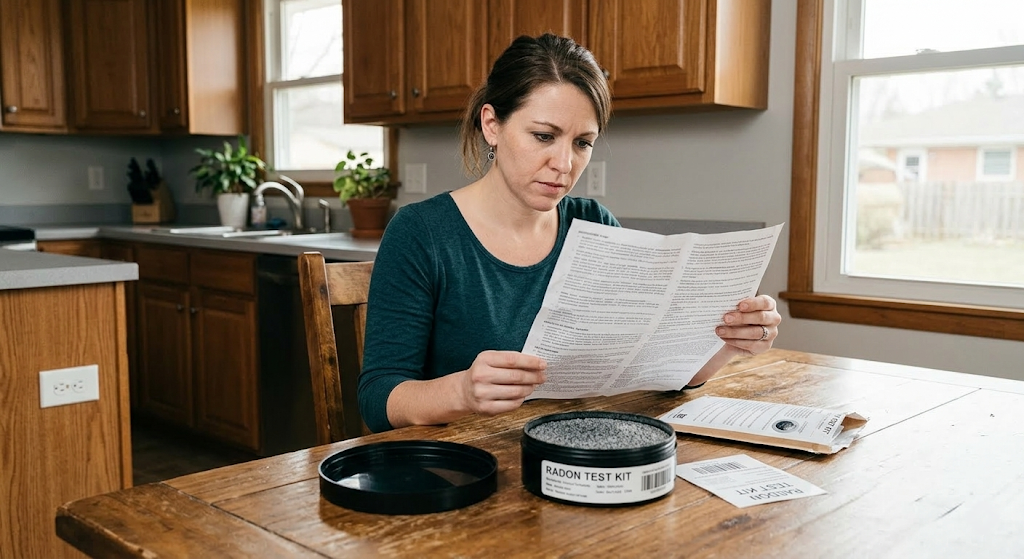
A DIY charcoal canister test kit costs $15–$30 at any hardware store. You set it in the lowest livable area, leave it for 48–96 hours, and mail it in — results in about a week.
Radon doesn't knock on the door. It exploits the physics of your house.
Your home acts like a chimney. Warm air inside rises and escapes through the upper levels, creating a slight vacuum at the bottom — particularly in the basement and at the foundation. The soil underneath your house is under slightly higher pressure than your basement air, so radon-laden soil gas gets pulled in through any opening it can find.
The most common entry points include:
- Cracks in the basement slab or concrete floor — even hairline cracks are enough
- Floor-to-wall joints and control joints — where the slab meets the foundation wall
- Sump pump pits — if your sump pit is open or loosely covered, it's basically a radon expressway into your basement
- Crawl space soil — if your crawl space isn't properly sealed with a vapor barrier, it's an open invitation
- Plumbing penetrations — gaps around pipes passing through slabs or walls
- Block wall cracks and mortar joints — especially in older Indiana basements with concrete block construction
If you've got a finished basement — a bedroom down there, a home office, a rec room where the kids hang out — this matters more. People spend significant time in finished basements, and radon concentrations are highest closest to the ground.
Your foundation type will also affect both how radon enters and what a mitigation system will cost. Basement homes are typically the simplest fix. Crawl space homes require more work. Slab-on-grade construction has its own set of solutions. A good contractor will walk your foundation before quoting — if they don't, that's a red flag we'll get to later.
One thing worth flagging: if you've already had a sump pump installed or done crawl space encapsulation work, those systems interact directly with radon pathways. A sump pit cover and a properly sealed crawl space are not substitutes for a mitigation system, but they're relevant context for whoever gives you a quote.
Testing for Radon — What It Costs, How It Works, and When to Do It

Continuous air quality monitors — like the Airthings Wave — let homeowners track indoor air in real time. For radon specifically, they're a great supplement to periodic certified tests. Photo: Pexels
Testing is easy. There's no good reason to skip it.
DIY Test Kits ($10–$50): A charcoal canister short-term test kit is available at any Menards, Home Depot, or Lowe's. You can also order through the National Radon Program Services (sosradon.org). Place the canister in the lowest livable area of your home, leave it for 2 to 4 days under closed-house conditions, then mail it to the lab. Results come back by email within a few days. Reliable for screening. Simple enough that there's no excuse not to do it this weekend.
Long-term test kits (alpha track detectors, 90+ days) give you a more accurate average over time. If you want to understand your annual exposure rather than a short-term snapshot, a long-term test is the better data point. These typically run $25–$45.
Professional Testing ($125–$400): If you're buying or selling a home in Indiana, DIY kits won't cut it for the transaction. Indiana law (410 IAC 5.1) requires that radon testing for real estate transactions be conducted by an ISDH-certified professional. That's not a technicality you can work around — it's state law.
If you have questions, the Indiana Radon Hotline is available at 1-800-272-9723 on weekdays 7am–6pm and weekends 9am–5pm. They can point you toward certified testers and answer basic questions at no cost.
Best time to test: October through April, when your home is closed up and heating season keeps windows shut. Closed-house conditions are when radon accumulates most — and when your test will reflect the actual level your family is breathing. That said, a test done in summer is still better than no test. Don't let timing become an excuse to delay.
If you want ongoing monitoring rather than a periodic test, continuous radon monitors like the Airthings Wave ($100–$250) give you real-time readings from your phone. They're not a substitute for a certified test in a transaction, but they're excellent for peace of mind and post-mitigation verification.
Cook County homeowners: request your free test kit through the Cook County Department of Public Health. Illinois state radon resources are available through both the Illinois Emergency Management Agency (IEMA) and the Illinois Department of Public Health (IDPH).
Radon Mitigation — What It Costs and What Actually Works
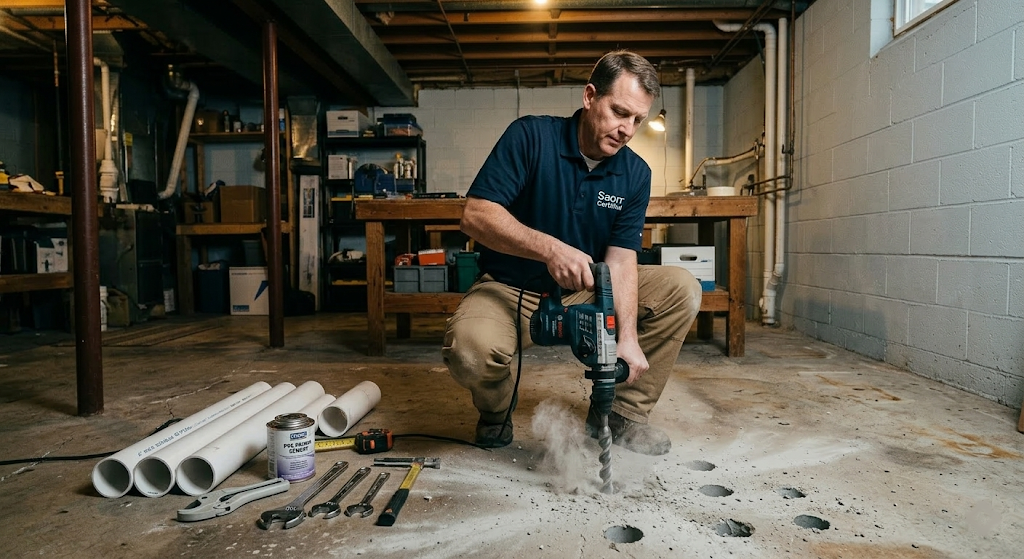
Sub-slab depressurization: a certified contractor drills through the slab, installs PVC pipe, and mounts a fan that pulls radon out from under the foundation before it enters.
If your test comes back at 4 pCi/L or higher, fix it. If it's between 2 and 4, the EPA recommends you consider fixing it. This isn't optional if you care about the people sleeping in your house.
Here's what actually works:
Sub-Slab Depressurization (SSD) — The Standard Fix
For the vast majority of Indiana and Chicago homes with basements, sub-slab depressurization is the gold standard. A contractor drills a hole through your basement slab, inserts a PVC pipe, and connects it to a continuously running fan that draws radon from the soil beneath your floor and exhausts it outside — up through the wall and above the roofline. This creates negative pressure below the slab, meaning radon can't build up in your living space. A properly installed system can reduce radon by up to 99%. Most Midwest homes can be fixed in a single day.
Sub-Membrane Depressurization (Crawl Space Homes)
If your home has a crawl space, the approach involves installing a vapor barrier membrane over the crawl space floor and running a fan beneath it to draw out the radon. This is more labor-intensive and often gets combined with crawl space encapsulation — a separate project that adds cost but addresses multiple problems at once.
What About Just Sealing the Cracks?
Caulk and sealants applied to cracks and sump pit covers are useful supplemental steps — but the EPA does not recommend sealing alone as a primary mitigation strategy. Sealing reduces entry points but doesn't change the soil pressure driving radon in. If a contractor leads with "let's just seal it up," get a second opinion.
How Much Does Radon Mitigation Cost?
| System Type | Best For | Typical Cost (Installed) |
|---|---|---|
| Sub-Slab Depressurization (SSD) | Basement / slab-on-grade homes | $800 – $2,500 |
| Sub-Membrane Depressurization | Crawl space homes | $1,500 – $4,000+ |
| Full Crawl Space Encapsulation + SMD | Crawl space with moisture issues | $2,500 – $6,000+ |
| Heat Recovery Ventilator (HRV) | Specific basement scenarios | $1,000 – $2,500 |
| Post-mitigation radon test | All systems (should be included) | Included or $15–$50 DIY |
Cost data sourced from BobVila.com and contractor pricing in the Indianapolis/Chicago market as of 2026. Actual costs vary by home size, foundation complexity, and local permit fees.
Annual fan operating cost is typically $25–$60 in electricity. These fans run 24/7, so quality matters — schedule 40 PVC and a name-brand radon fan are worth the modest premium over the cheapest available options.
All radon mitigators in Indiana must be ISDH-certified under 410 IAC 5.1. This is state law. No exceptions, no unlicensed workarounds. Additionally, look for NRPP (National Radon Proficiency Program) certification — the national credential that adds another layer of verified competence.
Hiring a Radon Mitigation Contractor — Questions to Ask Before You Sign
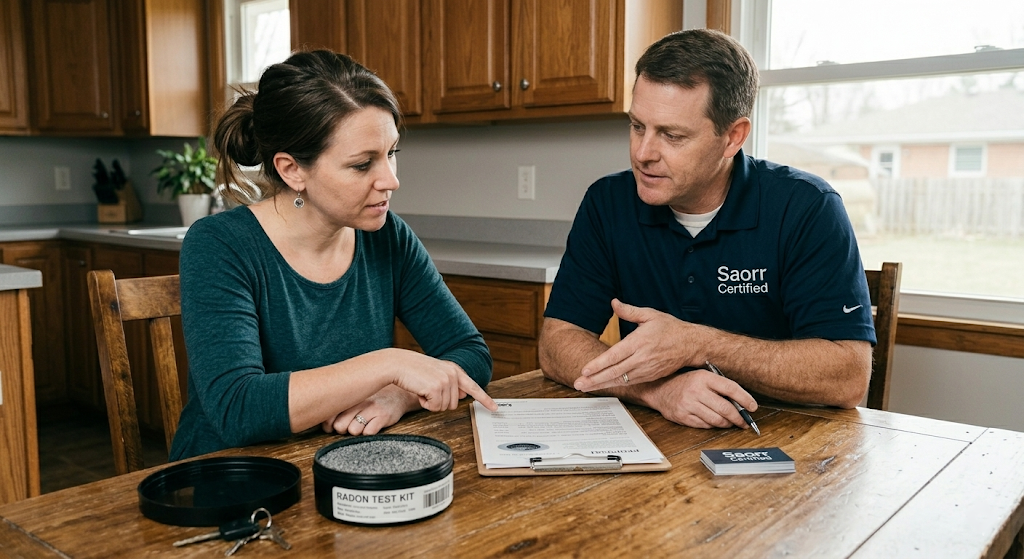
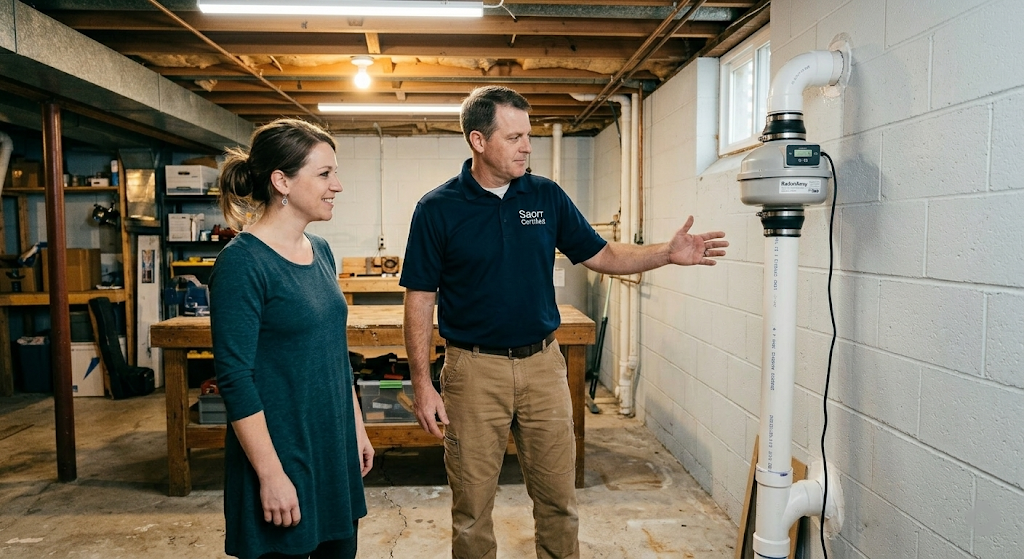
A good contractor will walk you through your test results, explain the system design, and give you a written quote before any work begins.
You've got a test result above 4 pCi/L. Now you need someone to fix it. Here's how to hire a radon contractor who knows what they're doing — and how to spot the ones who don't.
Verify credentials before anything else.
- Ask for their Indiana certification number and verify it at mylicense.in.gov. Takes two minutes. Do it.
- Ask if they hold NRPP or AARST-NRSD national certification. State certification is the minimum; national cert is a bonus that indicates ongoing professional development.
- Illinois contractors should be licensed through the Illinois Emergency Management Agency's radon program.
Ask these questions before signing anything:
- Will you do a pre-mitigation diagnostic — a pressure field test — before quoting? (Anyone who quotes without walking your foundation first is guessing.)
- What system do you recommend for my specific foundation type, and why?
- Where will the pipe exit the house? Above the roofline is preferred for health and aesthetics.
- Do you guarantee the system will bring my levels below 4 pCi/L — ideally closer to 2 pCi/L?
- What happens if the first installation doesn't hit the target? Is rework included?
- Is a post-mitigation test included in your quote?
- Will the system come with a U-tube manometer (the little pressure gauge on the pipe) so I can see it's working without retesting?
- Is a permit required in my municipality, and who pulls it?
Red flags that should send you to the next contractor:
- Quoting over the phone without seeing the house
- Refusing or unable to provide a license number
- Guaranteeing only "reduced levels" rather than a specific target
- Pushing crawl space upsells on a first call before diagnosing your actual problem
- No post-mitigation test in the proposal
Get at least three quotes. Not necessarily to find the cheapest option — a $900 quote and a $1,800 quote might both be reasonable depending on your home's complexity — but to understand what's included, what the contractor is planning to do, and whether their explanation of your situation makes sense.
The Bottom Line: Test Your Home. This Week.
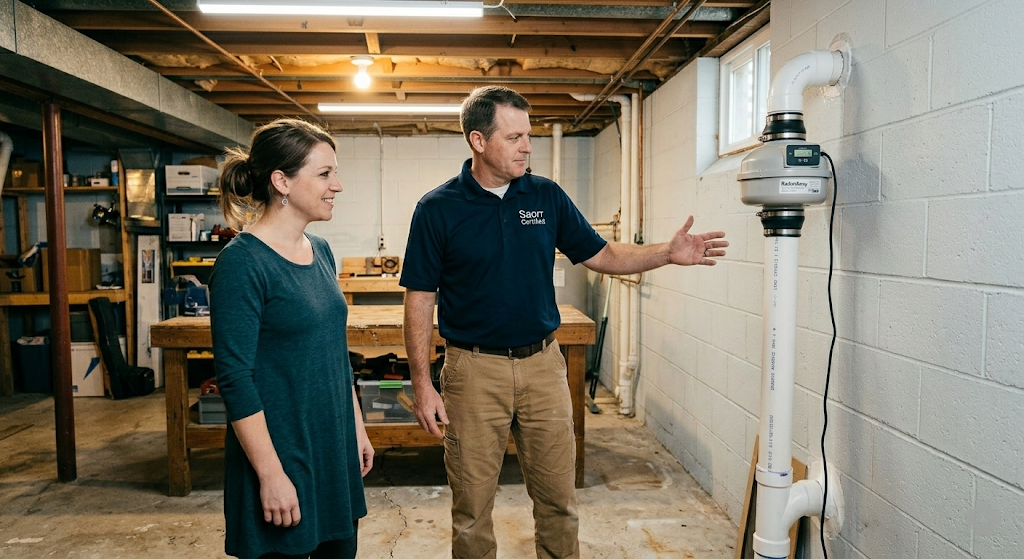
A properly installed mitigation system typically drops indoor radon levels below 2 pCi/L within 24 hours. Most systems run quietly and require minimal maintenance.
Gary's mitigation system cost $1,400. Marcus installed it in about six hours. Thirty days later, Gary did a follow-up test. His basement came back at 0.9 pCi/L — well below the EPA action level and even below the WHO threshold.
He texted his daughter's realtor: "Tell your buyer the mitigation system is already in."
That's the whole story. Radon is real. Indiana is a high-risk state. Nearly 1 in 3 homes here test above the action level. A test kit costs $15 at Menards. A fix costs roughly what you'd spend on a decent appliance. The only bad outcome here is finding out you had a problem and deciding to deal with it later.
Here's your action checklist:
- Buy a short-term radon test kit or order one online. If you're in Cook County, request a free one from the Cook County Department of Public Health.
- Place it in the lowest livable level of your home — your basement, your slab-level bedroom, wherever the family actually spends time.
- Mail it in. Wait for results.
- If you're at or above 4 pCi/L, start getting quotes from ISDH-certified radon mitigators. If you're between 2 and 4, seriously consider it.
- Hire an NRPP-certified contractor, verify their license, and ask the questions from this guide before signing anything.
This is one of the cheapest, most straightforward ways to reduce cancer risk in your household. The test is $15. The fix is $1,000–$2,000. The alternative is finding out years from now that you lived with a problem you could've solved on a Saturday afternoon at Menards.
Every radon contractor on Saorr is certified, background-checked, and ready to test and mitigate your home.
Ready to Get a Radon Quote?
Every contractor listed on Saorr for radon mitigation is ISDH-certified (Indiana) or state-licensed (Illinois). No unlicensed operators, no fly-by-night crews. Just verified professionals who can tell you what's under your slab and what it's going to cost to fix it.
Find a Certified Radon Contractor on Saorr →Find Trusted Pros Near You
Ready to start your project? Connect with vetted, top-rated contractors in your area.
Get Started