
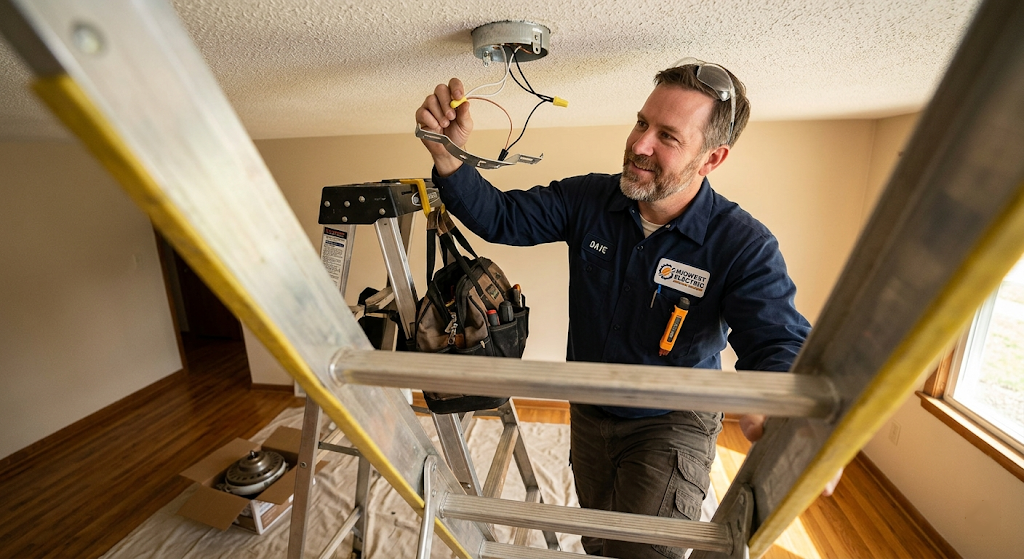
Ceiling Fan Installation Guide for Midwest Homeowners (2026)
Ceiling Fan Installation Guide for Midwest Homeowners (2026)

Ceiling fans make a room feel 4-6°F cooler without changing the thermostat - real comfort, real savings.
Here's the truth about Midwest summers nobody likes to say out loud: your central air conditioner is working overtime, and you're paying for every minute of it. Indianapolis hits average highs of 85°F in July. Columbus, Cincinnati, and Detroit aren't far behind - and that's before humidity turns "warm afternoon" into "surface of the sun." With electricity rates sitting at 12-15 cents per kilowatt-hour across the Great Lakes region in 2026, cooling your home is a real line item. A ceiling fan won't replace your AC, but it'll make you forget you ever wanted to crank it down. The wind-chill effect alone makes a room feel 4-6°F cooler without changing a single degree of actual air temperature - meaning you can push that thermostat up and let the fan do the heavy lifting. Spring is the window to get this done, before every electrician in Columbus, Cincinnati, Milwaukee, and Detroit is booked solid through August. Let's talk about how to do this right.
What Does Ceiling Fan Installation Actually Cost in 2026?
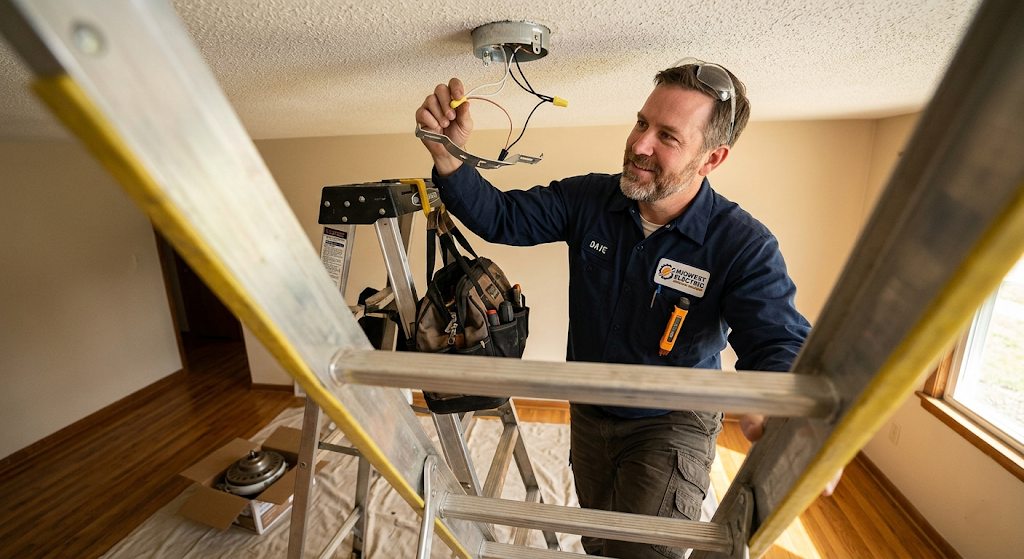
Let's start with money, because that's what this is really about. The national average for a ceiling fan installation - fan unit included - runs $247, with a typical range of $134 to $352 for a straightforward swap-out where wiring already exists. If you need new wiring run, that jumps to $300-$600 or more. Add in the fan unit itself - anywhere from $50 for a budget box-store model to $400-$1,400 for a premium smart fan - and you're looking at a wide spread depending on your starting point.
Midwest electrician rates by market:
| Markets | Electrician Rate | Typical Fan Install Cost |
|---|---|---|
| Chicago (city proper), Detroit metro, Minneapolis / St. Paul | $95–$130/hr | $400–$700+ (union premium, permitting) |
| Indianapolis, Columbus OH, Cleveland OH, Cincinnati OH, Milwaukee WI, Grand Rapids MI | $65–$100/hr | $250–$500 |
| Chicago suburbs (Naperville, Aurora), Indy suburbs (Carmel, Fishers), Ann Arbor MI | $75–$110/hr | $300–$550 |
The DIY case: if you're swapping a fan in a spot with existing wiring and a fan-rated box already in place, a competent homeowner can save $100-$200 in labor. Your all-in cost drops to $80-$300 (fan plus supplies) versus the professional version at $200-$500. That's real money. But "existing wiring" is doing a lot of work in that sentence - more on that below.
One more number: every Midwest state requires electrical permits for new circuit work. Budget $50-$150 for that permit when you're running new wire. Chicago specifically requires a city-licensed electrician for any new wiring - not just any licensed contractor, but someone with a Chicago city license. Columbus, Detroit, Milwaukee, and Minneapolis all have their own local permit processes too - your contractor should be pulling the permit, not you.
What Type of Fan Does Your Midwest Home Actually Need?
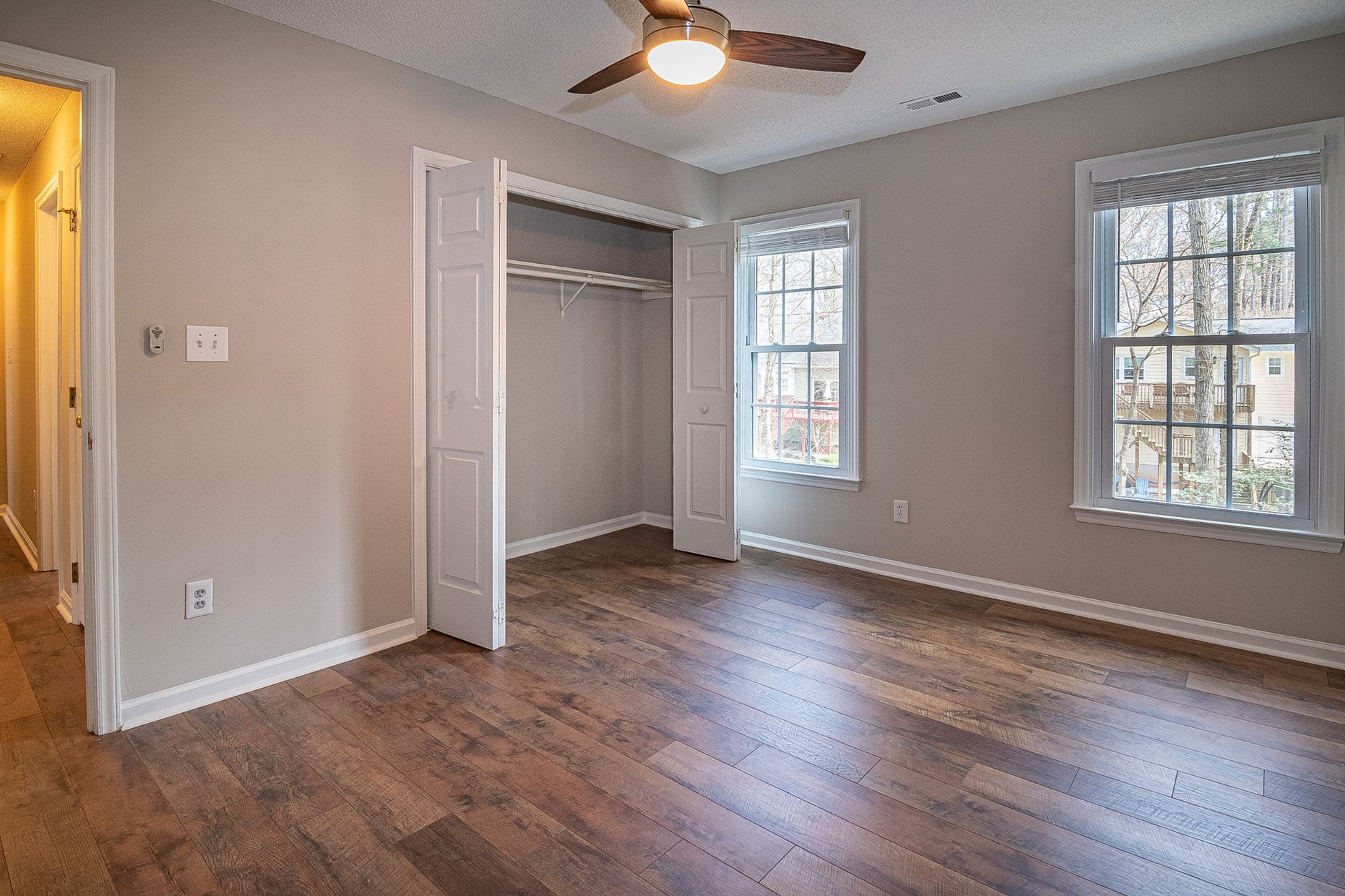
The right fan for the right ceiling height - hugger/flush mount fans are standard in the Midwest's abundant 8-foot ranch homes.
Not all ceiling fans are the same, and the wrong choice will either move no air or take somebody's head off. Here's the breakdown for the housing stock you're actually dealing with in the Midwest:
Standard Downrod Mount: Best for ceilings 9 feet or taller. The downrod hangs the fan motor 8-18 inches below the ceiling mounting bracket, which is the ideal position for airflow. If you're in one of Chicago's vintage 1920s-1940s brick buildings with those beautiful 9-to-10-foot ceilings, this is your fan. Get a 52-inch blade span for standard living rooms (150-400 square feet) and bump to 60 inches or more for great rooms.
Hugger / Flush Mount: This one's for the ranch homes. Indianapolis, Columbus, Cincinnati - the Midwest is wall-to-wall post-WWII ranch-style housing with 8-foot ceilings, and a standard downrod fan in an 8-foot room puts blades dangerously close to standing-height. A flush-mount hugger fan eliminates the downrod entirely. The trade-off is slightly reduced airflow efficiency (the ceiling proximity disrupts air circulation), but it's the right call for the ceiling height.
Outdoor-Rated Fans: If you're putting a fan on a covered porch, patio, or sunroom - and you should be, because Midwest summers on a covered porch are one of life's genuine pleasures - you need at minimum a damp-rated fan. Wet-rated fans handle direct exposure. Standard indoor fans will corrode, short out, and void their warranty inside of a season in Midwest humidity. Chicago's winters hit -20°F - if the fan stays up year-round, make sure it's rated for it.
Smart Fans: WiFi-enabled, app-controlled, voice assistant compatible - the premium tier is growing fast. They're legitimately useful, especially paired with a Nest or Ecobee thermostat. But here's the catch: smart fans and smart switches often require a neutral wire at the switch box, and a huge percentage of older Midwest homes were wired without one. If your home is older, check before you buy.
When You Need a Licensed Electrician - No Debate

New circuits, aluminum wiring, no existing box — these are not YouTube projects. Pull the permit, hire the licensed electrician.
Here's where the DIY conversation ends for a lot of homeowners, and it's better to know now than after you've already bought the fan. Call a licensed electrician when:
- There's no existing wiring at the fan location. Running new wire through finished walls and ceilings means fishing wire, cutting drywall, and connecting to your panel. This is permit-required work across every Midwest state.
- You don't have a fan-rated junction box. Millions of older homes have standard light fixture boxes at ceiling locations - rated for about 35 lbs of static load, not the dynamic torque of a spinning fan. These can and do fail, dropping a running fan. A fan-rated box is a $15-$30 part, but getting to it often requires attic or ceiling access.
- You have aluminum wiring. This is a big one in the Midwest. Homes built between 1965 and 1973 - and there are a lot of them across the region: Indianapolis (Broad Ripple, Irvington, Fountain Square), Chicago (Logan Square, Pilsen, Hyde Park), Detroit (Eastside, Rosedale Park), Columbus (Clintonville, Bexley), Cleveland (Lakewood, Parma), and Milwaukee (Bay View, Riverwest) - frequently have aluminum wiring instead of copper. Splicing copper fan leads directly to aluminum wire without AL/CO rated connectors is a fire hazard and a code violation. A licensed electrician needs to handle this.
- Your panel is outdated. Fuse boxes or early breaker panels may not safely support additional fan circuits.
- You've got cathedral or vaulted ceilings. Angled mounts, extended downrods, and structural considerations make this a pro job.
- You're installing on a covered porch with no existing outdoor-rated circuit.
Safety and Code Basics - The Non-Negotiables

A fan-rated junction box is a $15-$30 part. Using the wrong box is the number-one cause of ceiling fan falls.
Whether you're DIYing or watching a pro do it, these are the rules that matter:
Fan-Rated Junction Box (NEC 314.27(C)): The National Electrical Code requires that ceiling fan mounting boxes be specifically listed and rated for fan support - minimum 35 lbs, with most quality boxes rated to 70 lbs. This is non-negotiable. A standard light box is not a substitute.
Blade Height: The IRC requires fan blades to be at least 7 feet above the finished floor. Standard formula: 8-foot ceiling needs a flush mount or very short downrod; 9-foot ceiling needs a 12-18-inch downrod; 10-foot ceiling needs an 18-24-inch downrod. Minimum 18 inches of clearance from blade tip to any wall.
Blade Pitch: The sweet spot is 10-15 degrees. Flatter blades move less air; steeper pitch requires more motor power. Most quality residential fans come factory-set at 12-14 degrees - you shouldn't need to adjust this, but it's worth knowing.
Always Kill the Breaker: Not the wall switch - the circuit breaker. Flipping a wall switch only breaks the switched hot conductor; the circuit remains energized. Use a non-contact voltage tester to confirm the circuit is dead before touching anything. Every time.
Ground That Fan: The ground wire connects to both the fan bracket and the junction box. This is not optional.
The Energy Savings Math - Real Numbers
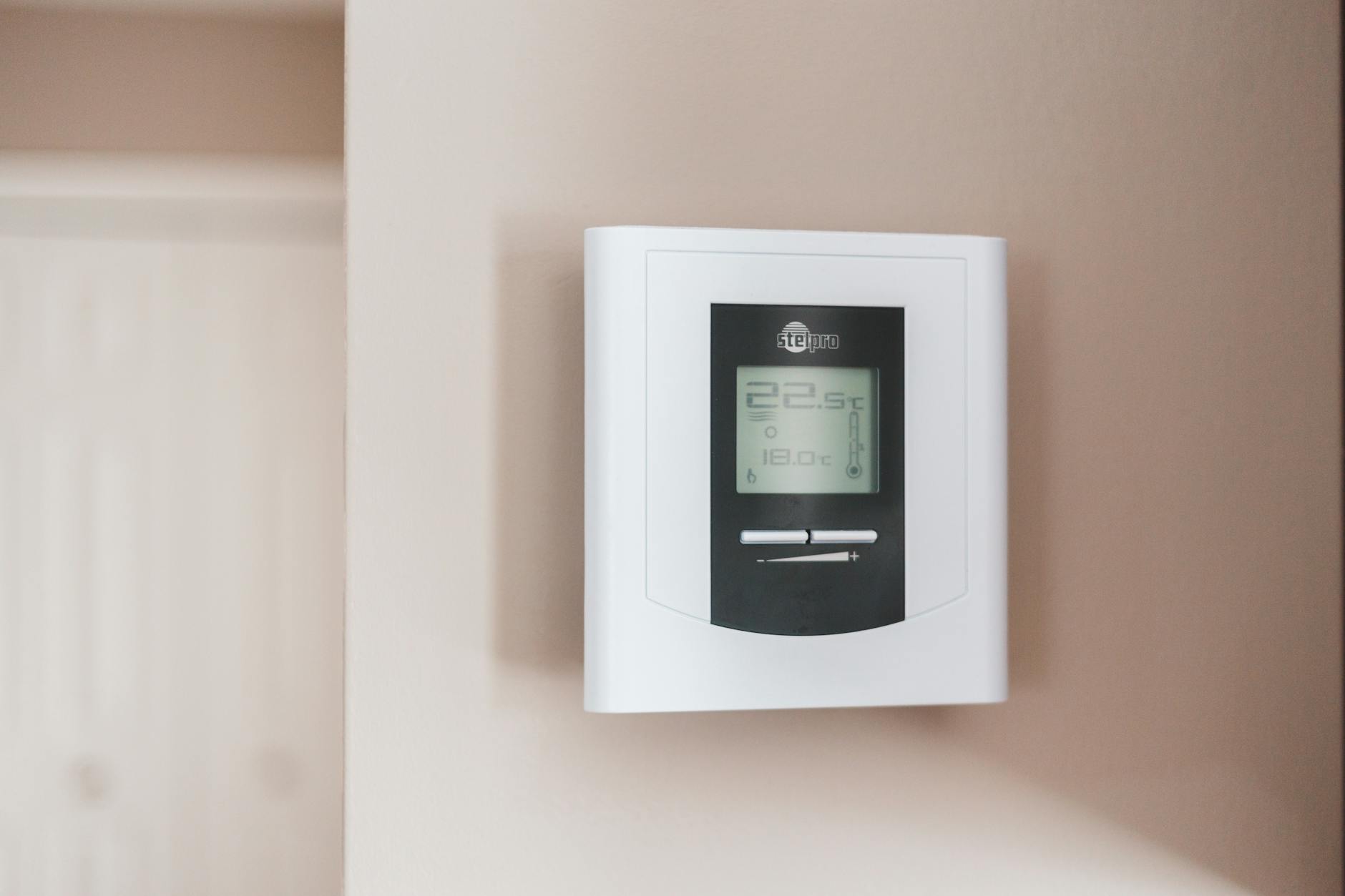
Bump the thermostat up 4°F, flip the fan on, and your AC bills drop 16–32%. That's the whole math.
Here's why ceiling fans are more than a comfort upgrade - they're a financial play. ENERGY STAR-certified ceiling fans use 60% less energy than conventional ceiling fan and light combinations. That's the EPA's number, not a marketing claim. Look for that label when you're shopping.
The thermostat trick is where the real money is: use your fan to raise the AC thermostat 4°F, and you're looking at roughly 4-8% energy savings per degree on your AC bill. Do the math: a 4-degree raise means potentially 16-32% lower AC costs for the summer. At Midwest electricity rates of 12-15 cents per kilowatt-hour (AES Indiana, ComEd, AEP Ohio, DTE Energy, We Energies – they're all in this range), that works out to $30-$100 saved per summer, per fan, depending on your home size and usage habits.
Compare the operating costs: a ceiling fan draws 15-75 watts (DC motor models run as low as 15-30 watts). Your central AC pulls 3,000-5,000 watts. Running a fan costs roughly $0.01-$0.05 per hour. Running your AC costs $0.30-$0.50 per hour. Every hour your fan keeps the AC off is money in your pocket.
Winter mode is the most overlooked feature on most ceiling fans: flip the direction switch to clockwise rotation at low speed and you're pulling cool air up and pushing the warm air trapped at your ceiling down along the walls. This can cut heating costs by 10-15% in rooms with higher ceilings. Most people never flip that switch. Now you know.
One rule: Turn the fan off when you leave the room. Fans cool people, not spaces. A running fan in an empty room is pure waste.
Common Mistakes That Come Back to Bite You
Here's where most DIY ceiling fan jobs go sideways:
- Using a light fixture box instead of a fan-rated box. This is the number-one cause of ceiling fan falls. The wobble and torque of a running fan loosens a non-rated box over weeks or months - until one day it comes down. Don't do this.
- Wrong downrod length. Blades too close to the ceiling kill airflow efficiency. Blades below 7 feet are a code violation and a head hazard for anyone taller than average. Measure the ceiling height before you buy.
- Not turning off the circuit breaker. Covered above, but worth repeating - the wall switch is not enough. Kill the breaker. Test with a voltage tester.
- Skipping the balance check. Unbalanced blades cause wobble, noise, and premature motor wear. Most fans include a balancing kit. Use it. It takes five minutes.
- Ignoring aluminum wiring. Splicing copper leads directly to aluminum house wiring is a fire risk and a code violation. If your home was built between 1965 and 1973 and you haven't had an electrician assess the wiring, do that first.
- Wrong fan for a damp or wet location. A standard indoor fan on a covered porch will corrode and potentially short out. Damp-rated minimum for any covered outdoor space.
- Mismatched fan size for the room. A 42-inch fan in a 400-square-foot great room won't move meaningful air. A 60-inch fan in a small bedroom is overkill and loud. Match the blade span to the room square footage.
- Smart fan without a neutral wire. Results range from flickering to the fan simply not functioning with a smart switch. Check your switch box wiring before buying a smart fan.
Midwest Market Realities: What's Different By City

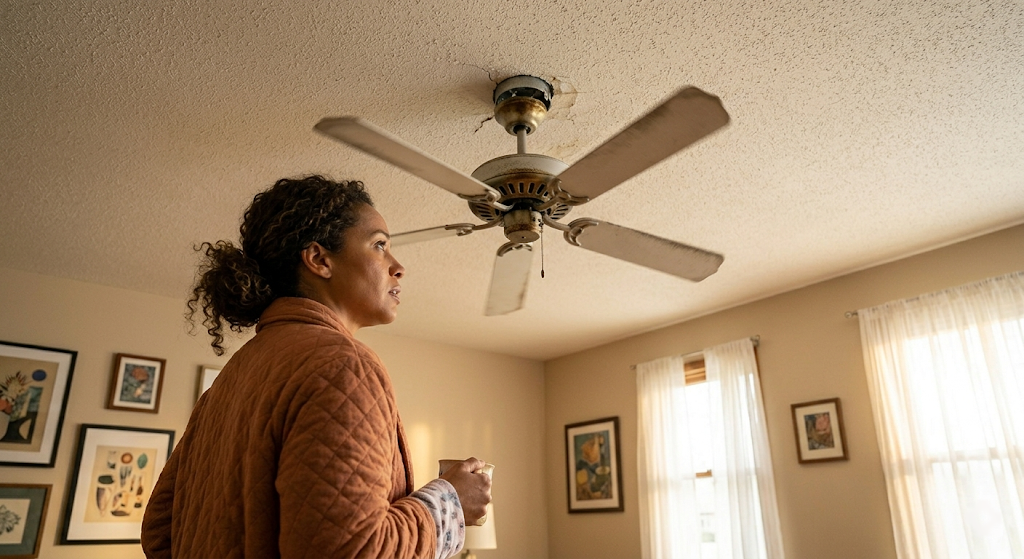
This is the house. Popcorn ceiling, 8-foot clearance, carpet — the standard Midwest ranch. Labor rates vary -/hr between a Chicago union shop and a Columbus independent, but the fan goes in the same box.
The Midwest is not a monolith. Here's what you need to know by market:
Indianapolis / Central Indiana: Dominated by 1950s-1970s ranch-style homes – 8-foot ceilings, hugger fans, and aluminum wiring in pre-1973 neighborhoods (Broad Ripple, Irvington, Fountain Square). Contractor market is available and affordable – same-week scheduling is realistic. Check aesindiana.com/rebates: AES Indiana (formerly IPL) occasionally offers rebates on ENERGY STAR-rated fans.
Columbus / Cleveland / Cincinnati (Ohio): Columbus housing stock is similar to Indianapolis – heavy ranch-era post-WWII builds with 8-foot ceilings in neighborhoods like Clintonville, Bexley, and Westerville. Cleveland's older housing (Lakewood, Parma) has more aluminum wiring exposure. AEP Ohio offers ENERGY STAR rebate programs. Columbus is the most competitive electrician market in Ohio – expect good availability.
Detroit / Grand Rapids / Ann Arbor (Michigan): Detroit's pre-1960 housing stock (Rosedale Park, Eastside, Grosse Pointe) features more 9-foot ceilings than typical Midwest ranch markets – downrod fans are viable here more often than in Indy or Columbus. Aluminum wiring is common in 1965–1973 builds across southeastern Michigan. DTE Energy offers rebate programs for ENERGY STAR products.
Milwaukee / Madison (Wisconsin): Milwaukee's bungalow and two-flat housing (Bay View, Riverwest) sits between Indianapolis and Chicago in ceiling height and complexity. We Energies offers ENERGY STAR appliance rebates. Union presence is lower than Chicago, keeping costs closer to the Indianapolis/Columbus range.
Chicago / Northeast Illinois: Vintage building stock – 1920s and 1930s brick two-flats, courtyard buildings, greystone apartments – features 9-to-10-foot ceilings ideal for standard downrod fans. Complex permitting environment and higher labor costs. Chicago requires city-licensed electricians for new wiring. ComEd offers ENERGY STAR rebates and smart thermostat incentives – stacking both can double your savings.
Fundamentals are the same everywhere: check your ceiling height, check your wiring age, match the fan to the room, and don't cut corners on the junction box.
Frequently Asked Questions

Can I install a ceiling fan myself?
Yes - if you're replacing an existing fan or light fixture that already has fan-rated wiring and a fan-rated junction box, a basic fan swap is within reach for a competent DIYer. Turn off the breaker, verify with a voltage tester, follow the fan's instructions, and you can save $100-$200 in labor. If any of those conditions aren't met - no existing wiring, no fan-rated box, or aluminum wiring in the home - stop and call a licensed electrician.
How long does ceiling fan installation take?
A straightforward swap of an existing fan: 1-2 hours for a DIYer, less for a pro. A new installation requiring new wiring, a new box, and potentially a new circuit from the panel can take 4-8 hours of professional labor, depending on access and complexity. Factor in permit pull and inspection time for new circuit work.
Do I need a permit to install a ceiling fan?
For a simple fan swap - same box, same wiring, no new circuits - generally no permit is required anywhere in the Midwest. The moment you're running new wire or adding a new circuit, you need a permit. In Chicago, any new wiring work requires both a permit and a city-licensed electrician. Columbus, Detroit, Milwaukee, and Minneapolis all have similar requirements for new circuit work. When in doubt, call your local building department - it's a free phone call and it protects you if you ever sell the home.
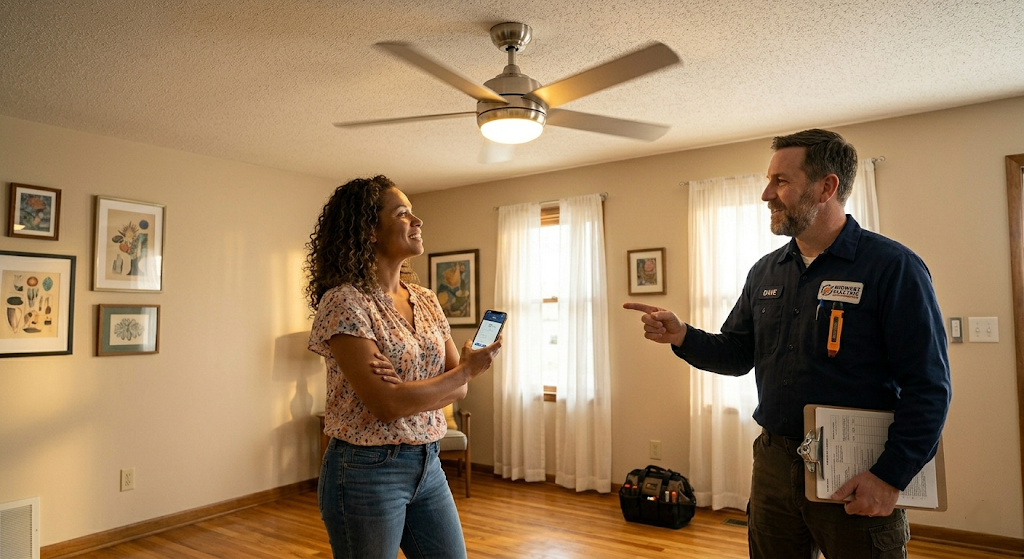
Ready to Get This Done Right? Find a Licensed Electrician on Saorr.
You've got the information. Now you need the right person for the job - especially if your home has aluminum wiring, needs new circuits, or you just want it done correctly the first time without standing on a ladder for two hours. Saorr connects Midwest homeowners with licensed, vetted electricians in Indianapolis, Chicago, Columbus, Cincinnati, Milwaukee, and beyond. No guessing, no hoping the handyman you found online knows electrical code. Just qualified professionals who show up, do the work right, and charge a fair price.
Ready to get this done right? Find a licensed electrician on Saorr.
Spring is the smart time to move on this - before summer demand books every electrician in the city solid through Labor Day. Get ahead of the heat, lower your energy bill, and stop running that AC harder than you have to. A ceiling fan is one of the best dollar-for-dollar upgrades you can make to your home. Do it once, do it right.
Find Trusted Pros Near You
Ready to start your project? Connect with vetted, top-rated contractors in your area.
Get Started