Composite Decking Installation Guide
Composite Decking Installation: What It Really Costs in 2026
Your wood deck is rotting. You've been stepping around the soft spots for two summers now, and somewhere in the back of your mind you know it's only a matter of time before a board gives out. So you start looking into composite decking — and the first quote you get makes you spit out your coffee.
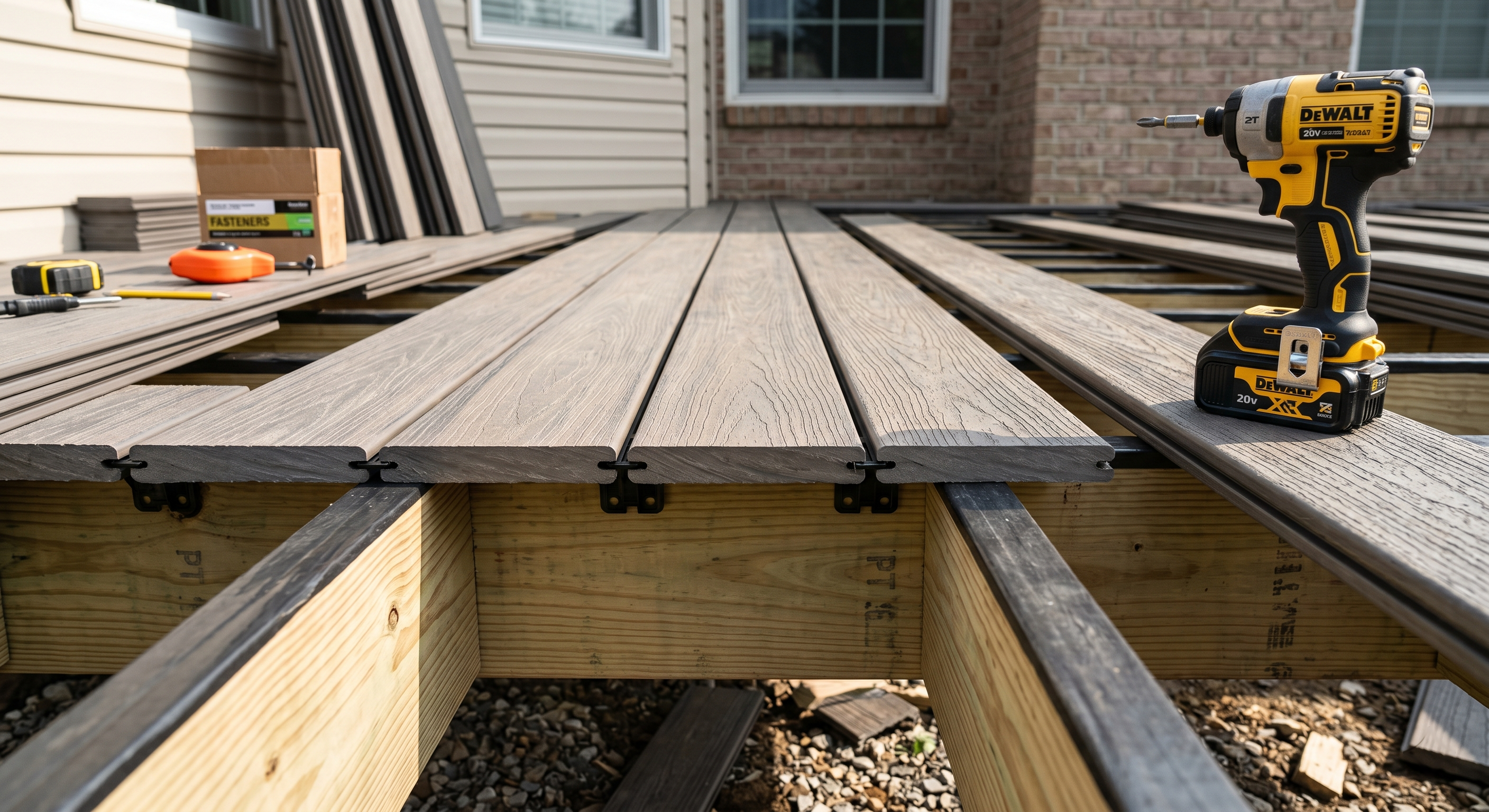
Yeah, composite costs more upfront than pressure-treated wood. That part's real. But here's the thing most contractors won't tell you unless you ask: over 15 years, composite and wood end up costing about the same. Except wood requires staining every couple of years, splinters underfoot, warps in the heat, and eventually rots right back where you started. Composite just sits there looking good while you drink your coffee in peace.
This guide breaks down what composite decking installation actually costs in 2026 — by region, by material tier, and by the factors that can blow your budget before the first board is even cut. We'll cover what's included in a full install, which brands are worth the money, whether DIY is realistic, and how to find a contractor who won't take shortcuts on the framing. Let's get into it.
What You're Actually Paying For

The national average for composite deck installation runs $25–$50 per square foot installed, or roughly $10,000–$20,000 for a 400 sq ft deck (think 20×20 — a solid family-sized space). Most homeowners land in the $12,000–$18,000 range for a project that size with standard railings and a simple layout.
Here's what that price actually covers:
- Substructure framing: Composite boards are surface boards only — the structural frame underneath is still pressure-treated lumber. Framing adds $3–$8/sq ft to material cost. Don't let anyone skip this or cut corners with untreated wood.
- Composite decking boards: The surface you walk on. Most are 1×6 or 5/4-profile boards. Hidden fastener systems (like Trex Hideaway) add $1–$3/sq ft but eliminate visible screw holes — worth it on premium installs.
- Footings: Concrete piers that hold the whole structure. In freeze-thaw climates (Northeast, Midwest, Mountain West), footings must go below frost line — sometimes 42–48 inches. Figure $300–$600 per footing.
- Railings: Composite or aluminum railing systems run $20–$60/linear foot installed. Cable railings are $100–$200/linear foot. Code requires railings on any deck more than 30 inches off grade.
- Stairs: $300–$700 for a standard 3–5 step run. More if you're doing composite stringers and treads.
- Permits: Most jurisdictions require a permit for any attached or elevated deck. Permit fees range from $150 in smaller suburban markets to $1,200+ in NYC and San Francisco. Your contractor should pull the permit — ask explicitly.
- Old deck demo: If you're replacing an existing deck, add $500–$1,500 for demo and disposal. This often turns up rotted ledger boards, which adds another $500–$1,500 to repair.
Bottom line: a 400 sq ft deck with standard railings, one stair run, and a permit is a $12,000–$20,000 project in most markets. You can get to $25,000+ with premium boards, cable railings, a second-story elevation, or a complex shape. The sections below will tell you exactly where your zip code falls.
What Composite Decking Installation Costs Across the US

Labor is the biggest regional variable — it's 35–40% of your total project cost, and it swings hard depending on where you live. Material costs are relatively uniform nationwide (composite boards ship from the same factories). What moves the number is what contractors charge per hour in your market, how deep footings need to go, how complicated your permitting is, and how much competition exists for deck work in your area.
All prices below are for a 400 sq ft deck — standard straight layout, composite boards, aluminum or composite railing, one stair run, permit included, no demo. Adjust up for second-story decks (+$40–$50/sq ft), custom shapes (+$700–$1,400), or cable railings (+$100–$200/linear ft).
Northeast — Maine, New Hampshire, Vermont, Massachusetts, Rhode Island, Connecticut, New York, New Jersey
Boston, New York City (T1): $30–$58/sq ft → $12,000–$23,200 for 400 sq ft
Hartford, Providence, Albany (T2): $27–$54/sq ft → $10,800–$21,600 for 400 sq ft
The Northeast is one of the most expensive regions in the country for deck work, driven by union labor density, high cost of living, and NYC's prevailing wage requirements. On top of that, freeze-thaw cycles mean footings must go 36–48 inches deep — add $300–$600 per footing compared to Southern markets. NYC permits run $400–$1,200 with mandatory DOB filings; Boston is $200–$600. Book your contractor by March if you want a spring install — most good crews are locked in by then. In coastal New England (Cape Cod, South Shore, Narragansett Bay), PVC or fully-capped composite like Azek is strongly recommended for moisture resistance. Older urban homes in Boston and Albany frequently have rotted ledger boards — budget an extra $500–$1,500 for that repair.
Mid-Atlantic — Pennsylvania, Maryland, DC, Virginia, West Virginia, Delaware
Washington DC, Baltimore (T1): $27–$56/sq ft → $10,800–$22,400 for 400 sq ft
Pittsburgh, Richmond (T2): $26–$52/sq ft → $10,400–$20,800 for 400 sq ft
DC proper carries a 20–30% labor premium over the national average, driven by union density and prevailing wage rules. The DCRA permit process can take 4–8 weeks and run $300–$800 — factor that into your timeline. Northern Virginia and Maryland suburbs (Fairfax County, Howard County, Montgomery County) are HOA-dense; board approval before you even pull a permit is standard in most planned communities. Pittsburgh is a different story — labor is near national average, but the hilly terrain means multi-level or elevated decks cost significantly more (add 20–35% for serious grade changes). Richmond is a growing suburban market with competitive contractor availability and faster permitting than DC.
Southeast — North Carolina, South Carolina, Georgia, Florida, Alabama, Mississippi, Tennessee, Kentucky
Atlanta, Miami, Charlotte (T1): $26–$52/sq ft → $10,400–$20,800 for 400 sq ft
Raleigh, Tampa, Nashville (T2): $25–$50/sq ft → $10,000–$20,000 for 400 sq ft
The Southeast is near national average on labor, but climate scope adds cost in specific markets. Miami is the big exception: extreme humidity, salt air, and Miami-Dade county hurricane fastening requirements push projects $1,500–$3,000 higher — and PVC composite like Azek is essentially non-negotiable for anything near the coast. Atlanta's deck market is one of the fastest-growing in the country; contractors are busy year-round, and spring bookings fill by February. HOAs are extremely common in Southeast suburbs (Alpharetta, Cary, Brentwood, Ballantyne) — many specify decking color and railing material; add 2–8 weeks for board approval. Nashville's Williamson County suburbs are hot for premium composite installs; Raleigh's Research Triangle boom is driving strong demand with good contractor supply.
Midwest — Ohio, Indiana, Illinois, Michigan, Wisconsin, Minnesota, Iowa, Missouri, and surrounding states
Chicago, Detroit, Minneapolis (T1): $28–$56/sq ft → $11,200–$22,400 for 400 sq ft
Indianapolis, Columbus, Milwaukee (T2): $25–$48/sq ft → $10,000–$19,200 for 400 sq ft
Chicago's union carpenter presence pushes T1 Midwest costs 15–25% above national average, and frost-line depth (42–48 inches in Chicago and Minneapolis) means footings are meaningfully more expensive than in Southern markets. The Midwest deck season is also the most compressed in the country — April through June is essentially the entire window. Contractors are booked by late February; if you're in Minneapolis, book in January for a spring install. The good news: Indianapolis and Columbus are two of the best-value composite deck markets in the country. Labor rates are at or near national average, contractor competition is strong in the suburbs (Carmel, Dublin, Westfield), and you can get a high-quality 400 sq ft install for $10,000–$15,000 with mid-range boards.
South & Gulf Coast — Texas, Oklahoma, Louisiana, Arkansas, Mississippi
Houston, Dallas (T1): $26–$50/sq ft → $10,400–$20,000 for 400 sq ft
San Antonio, Austin, Oklahoma City (T2): $25–$48/sq ft → $10,000–$19,200 for 400 sq ft
Texas and the Gulf Coast run 5–10% above national average in T1 markets, driven by growth-suburb demand in The Woodlands, Frisco, Katy, and Southlake. Houston's humidity is a real concern — capped composite handles the heat-humidity combo far better than uncapped boards, which absorb moisture through the exposed wood fiber core and degrade faster. In Dallas, UV fading is the bigger issue; Trex Transcend and TimberTech both offer better fade warranties than entry-level lines. Permitting is generally faster here (2–4 weeks in most suburban markets, $150–$400). Oklahoma City is one of the most affordable T2 markets in the country for composite work — at or slightly below national average with solid contractor availability.
Mountain West — Colorado, Utah, Nevada, Arizona, New Mexico, Idaho, Wyoming, Montana
Denver, Phoenix (T1): $27–$53/sq ft → $10,800–$21,200 for 400 sq ft
Salt Lake City, Boise, Albuquerque (T2): $25–$50/sq ft → $10,000–$20,000 for 400 sq ft
Denver sits 10–15% above national average and has two climate factors working against cheap installs: freeze-thaw cycles (footing depth 36–42 inches) and high-altitude UV intensity that degrades lower-quality composite faster. Trex Transcend or TimberTech are the right call here — their fade warranties are backed by actual testing at elevation. Phoenix is the opposite climate problem: surface temperatures on composite boards can hit 150°F+ in direct Arizona sun. Light-colored composite boards absorb significantly less heat than dark ones � in Phoenix, opt for lighter tones in the Trex Transcend or TimberTech Pro lines. Phoenix permits are faster (2–3 weeks) and cheaper ($150–$350). Boise is trending upward as population growth tightens contractor supply; Albuquerque remains the most affordable market in the Mountain West.
Pacific Coast — California, Oregon, Washington, Alaska, Hawaii
Seattle, Los Angeles, San Francisco Bay Area (T1): $32–$62/sq ft → $12,800–$24,800 for 400 sq ft
Portland, San Diego, Sacramento (T2): $28–$57/sq ft → $11,200–$22,800 for 400 sq ft
The Pacific Coast is the most expensive region in the country for deck installation, full stop. San Francisco Bay Area labor runs 50–60% above national average; permits alone can cost $400–$1,200, and some Bay Area cities require a structural engineer to review elevated deck plans. Seattle's wet climate makes PVC or fully-capped composite the standard choice — covered deck additions (pergolas, roofed structures) are popular here and add $5,000–$15,000 to any project. In California's Very High Fire Hazard Severity Zones (much of suburban LA, parts of the Bay Area), composites must carry a Class A fire rating — Trex Transcend and Fiberon qualify, but not every product does. Portland is more affordable than Seattle but carries the same moisture-resistance priorities; Sacramento is the most competitive Pacific Coast market by a solid margin.
Composite Decking Brands: Good, Better, Best

Not all composite is created equal. The difference between a $4/sq ft board and a $13/sq ft board isn't just aesthetics — it's how the board is manufactured and what's protecting the wood fiber core.
Entry-Level ("Good") — $4–$6/sq ft material
Veranda, Deckorators — Both available at big-box stores. These are uncapped or minimally capped composites. They'll work, but they're more susceptible to fading, staining, and moisture absorption over time. Best for tight budgets on ground-level decks with good drainage and full sun (not shaded or wet environments).
Mid-Range ("Better") — $5–$10/sq ft material
Trex Enhance / Select, Fiberon Good Life & Sanctuary — This is where most homeowners land. Trex is the market leader for a reason: wide distribution, solid warranty, and contractors who know how to work with it. Fiberon offers comparable quality at slightly lower prices and is commonly available at Home Depot. Boards in this tier are capped or partially capped — significant upgrade over entry-level in fade and stain resistance.
Premium ("Best") — $10–$17/sq ft material
Trex Transcend, TimberTech AZEK, Fiberon Paramount, Azek — Fully capped on all four sides. Virtually impervious to moisture, mold, staining, and UV fading. TimberTech and Azek are actually the same parent company (AZEK Group) and are among the most durable composites on the market. Azek is PVC-based — the right call for shady, wet, or coastal environments. Trex Transcend has one of the best-looking wood grain textures in the category. At this tier, you're buying a deck that will outlive your mortgage.
Quick rule of thumb: If you're in a wet climate, coastal area, or heavily shaded yard, go capped composite or PVC minimum. If you're in a dry, sunny climate, mid-range capped composite handles it well. Don't pay premium prices for entry-level boards — the long-term cost difference is real.
DIY vs. Hiring a Pro

Labor runs $10–$15/sq ft for composite deck installation. On a 400 sq ft project, that's $4,000–$6,000 you could theoretically save by doing it yourself. So — should you?
DIY is realistic if:
- You've built things before (framing, basic carpentry)
- Your deck is ground-level or low-elevation (not second-story)
- You're attaching to a new or verified-solid ledger (existing rotted ledger = hire someone)
- You're comfortable pulling your own permit and passing inspections
- You have access to a miter saw, circular saw, drill, and about $200–$500 in tool rental costs
Hire a pro if:
- Your deck is elevated more than 3–4 feet off grade
- You're dealing with an old home where the ledger condition is unknown
- Your municipality requires a licensed contractor to pull permits
- You're in a freeze-thaw market (Northeast, Midwest, Mountain) where footing depth and concrete work require experience
- You have a non-rectangular layout, multiple levels, or stairs with complex geometry
The single biggest risk on a DIY deck is the ledger — the board that attaches your deck to your house. Improper ledger flashing is the number one cause of deck failures and water intrusion into your home. Even committed DIYers often hire a contractor for the ledger and footing work, then handle the boards and railings themselves. That hybrid approach can save $2,000–$3,000 while keeping the structural work in professional hands.
How to Hire a Composite Deck Contractor

Finding a good deck contractor isn't hard. Finding one who won't rush the framing to get to the boards faster — that takes a little more effort. Here's how to do it right:
What to look for
- Licensed and insured. General liability and workers' comp are non-negotiable. Ask for certificates before signing anything.
- Experience with composite specifically. Composite boards behave differently than wood — they expand and contract with temperature, require specific fastener spacing, and certain brands have proprietary clip systems. Ask how many composite decks they've built in the last year.
- Pulls their own permits. Any contractor who suggests skipping the permit is waving a red flag. A no-permit deck can cause problems when you sell your home and will likely fail inspection if you try to add it retroactively.
- References from similar projects. Ask for 2–3 homeowners with comparable projects (similar size, elevation, material) you can contact directly.
- Clear written quote. The quote should itemize: materials (brand and line), labor, permit cost, demo (if any), and what's explicitly not included.
Red flags to watch for
- Lowball quote with vague scope ("composite decking installed, TBD on brand")
- Requesting more than 30–40% deposit upfront
- No mention of permits in the quote
- Can start "next week" in peak season (April–June) — good contractors are usually booked 4–8 weeks out
- Suggesting you skip railings on an elevated deck "to save money" — that's a code violation
Get at least three quotes
In tight markets (Boston, NYC, SF Bay Area, Seattle), getting three quotes takes effort — but it's worth it. In more competitive markets (Atlanta, Columbus, Dallas suburbs, Phoenix), quotes are easier to gather. Price difference between quotes for the same scope commonly runs 20–35%. The lowest quote isn't always wrong, but it warrants a closer look at what's included.
Timing your project
Booking off-peak gets you better availability and sometimes better pricing. In the Northeast and Midwest, late September through November is when contractors start having open slots. In the South and Gulf Coast, December through January is slow season. In the Mountain West (Denver, SLC), November through February is off-peak. Year-round markets (Phoenix, LA, San Diego) have less seasonality, but January–February is still the softest window for scheduling.
Composite vs. Wood: The Real Long-Term Math

Let's do the math that makes composite worth it:
- Composite upfront (400 sq ft): $12,000–$20,000
- Pressure-treated wood upfront (400 sq ft): $7,000–$12,000
- Wood maintenance (stain/seal every 2–3 years): ~$400–$700 per treatment × 5–6 times over 15 years = $2,000–$4,200
- Wood deck replacement at year 12–15: $7,000–$12,000 again
By year 15, a homeowner who chose pressure-treated wood has spent roughly the same as one who chose composite — and the composite deck still has 10–15 years of life left with zero maintenance beyond an occasional rinse. The wood deck is due for full replacement, and the homeowner has spent multiple weekends per year refinishing it.
The composite argument isn't "spend less money." It's "spend roughly the same money and get twice the life with none of the maintenance." For most homeowners, that's a straightforward trade.
Ready to Get Started?

Composite decking is one of the better home investments you can make — it improves your outdoor living space immediately, holds up for 25–30 years without maintenance headaches, and adds real value when it's time to sell. The upfront cost stings, but the long-term math is genuinely in your favor.
Here's where to start:
- Know your region's price range. Use the numbers above to set a realistic budget before talking to contractors. Don't let the first quote surprise you.
- Pick your material tier. For most homeowners in most climates, mid-range capped composite (Trex Select, Fiberon Sanctuary) hits the right balance of quality and cost. Go premium if you're in a wet climate, coastal area, or buying the house you plan to die in.
- Get three quotes. Describe the same project to all three. Compare scope, not just price.
- Book early. In the Northeast and Midwest especially, spring slots disappear fast. If you want a summer deck, start talking to contractors in February.
Your deck is rotting. You've known it for two summers. Now you know exactly what it costs to fix it right — for the last time.
Find Trusted Pros Near You
Ready to start your project? Connect with vetted, top-rated contractors in your area.
Get Started