Deck Staining & Sealing Guide — Midwest Spring 2026
Deck Staining and Sealing Guide for Midwest Homeowners — Spring 2026
Spring finally arrives in the Midwest and the deck comes back into focus. After five months of freeze-thaw cycles, ice, salt, and snow, most wood decks in Columbus, Detroit, Milwaukee, and Grand Rapids are showing their age — grayed boards, peeling stain, or that slow soak-in when you set a wet glass down. The instinct is to get out there the first warm weekend and start rolling on fresh stain.
Slow down. That instinct is right on the goal but wrong on the timing. Staining a deck too early — or skipping proper prep — is one of the most common and expensive mistakes Midwest homeowners make. The good news: done right, a fresh stain and seal protects your deck for years and costs a fraction of what board replacement runs. Here's everything you need to know for spring 2026.

Is Your Deck Actually Ready to Stain?
Before you think about products or contractors, do a two-minute assessment. You need to know what you're dealing with before you spend money on the wrong solution.
The screwdriver test: Press the tip of a standard screwdriver firmly into several deck boards, especially near posts, around fasteners, and anywhere boards sit close to the ground. If the tip sinks into the wood with light pressure, you have rot. Staining over rotted wood is money wasted — the boards need to be replaced first. This is especially common on older decks in Cleveland, Detroit, and Milwaukee where decades of freeze-thaw cycling have worked water into end grain and post bases.
The water bead test: Splash a cup of water onto a dry board. If it beads up like water on a waxed car, the existing sealant is still doing its job — you may not need to restain yet. If the water soaks in within 30 seconds, the sealant has failed and it's time to treat the wood.
Visual inspection: Look for fading, cracking, graying boards, dark water stains, visible mold or mildew growth, and splintering. Any of these are clear signals that protection has failed.
New lumber check: If you built or added to your deck in the last 6–12 months using pressure-treated lumber, do not stain it yet. New PT lumber needs 6–12 months to cure and dry out before it will accept stain. The water bead test confirms readiness — if the wood still beads, the preservatives are still in the surface and stain won't adhere properly.

Timing: When to Stain in the Midwest
Timing is where Midwest homeowners most often go wrong, and where national guides most often let you down. The rules are different here.
Temperature floor: Stain must be applied when air and surface temperatures are consistently above 50°F — and ideally below 90°F. Below 50°F, stain doesn't cure properly; above 90°F, it dries too fast and doesn't penetrate the wood. In practical terms for the Great Lakes region:
- Columbus and Indianapolis: Last frost averages mid-April. Safe staining window opens late April, with early-to-mid May being the sweet spot.
- Detroit and Milwaukee: Last frost runs late April to early May. Aim for mid-May at the earliest for reliable conditions.
- Grand Rapids and Cleveland: Similar to Detroit — late April through May, with May being the reliable target.
Best Midwest window: Late April through mid-May is the primary spring opportunity. A secondary fall window exists in early-to-mid September, after the summer heat breaks but before temperatures drop. Both windows work; spring is more popular and contractors book up fast.
Dry wood requirement: Wood must be dry for at least 48 hours before staining. In Midwest springs, this can be the hardest condition to hit — April brings frequent rain across Ohio, Indiana, Michigan, and Wisconsin. Check the five-day forecast and don't start prep until you have a clear 48-hour window before your stain day.
Why the Midwest is different: Repeated freeze-thaw cycles force water in and out of wood fibers all winter, breaking down the cellular structure faster than in southern or coastal climates. A deck in Columbus or Detroit degrades more quickly over winter than the same deck in Nashville or Portland. That's not a reason to panic — it's a reason to treat spring restaining as structural maintenance, not optional cosmetic work.

Prep Steps: The Work That Actually Matters
Eighty percent of a good stain job is prep. Products applied over dirty, wet, or deteriorated wood fail early no matter how much you spend on the stain itself.
1. Power washing: Always required. This removes dirt, mildew, gray oxidation, and any loose or failing stain from the surface. Use a pressure washer at 1,200–1,500 PSI for most deck wood — too much pressure can raise the grain and damage softer boards. After washing, let the deck dry a full 48 hours minimum, and 72 hours if conditions are humid.
2. Stripping (if needed): If your deck has an old solid-color stain or paint, it needs to come off before you restain. Stripping involves a chemical deck stripper, additional pressure washing, and often hand-scraping in corners and around railings. This adds significant cost and labor — budget $1.50–$3.00 per square foot extra if your deck needs it.
3. Brightening: Pressure-treated pine, which is the dominant deck material across the Midwest, tends to gray and weather more quickly than cedar or redwood. A wood brightener (typically oxalic acid-based) restores the natural tone and opens the wood grain to better accept stain. This step is especially worth doing on any deck that's gone noticeably gray.
4. Sanding: Light sanding with 60–80 grit is recommended to smooth raised grain after washing and to knock down any remaining rough spots or splintering. For heavily weathered boards, more intensive sanding may be needed ($1.00–$4.00 per square foot depending on scope). You don't need to sand the whole deck like finish carpentry — just enough to create a smooth, clean surface for the stain to bond to.
5. Repairs: Replace any boards that failed the screwdriver test. Tighten loose fasteners. Check the ledger board where the deck connects to the house — failed flashing here allows water intrusion into your home structure, and no amount of staining fixes that problem. Fix structural issues before staining, not after.

Stain Types: Solid, Semi-Transparent, and Clear
The right product depends on the condition of your wood and how much of the natural grain you want to preserve.
Clear / transparent stains and sealers: These protect the wood while letting the natural grain show completely. They look great on new, clean, attractive wood — but they offer the least UV and weather protection of the three options. On pressure-treated pine (which is most Midwest decks), clear finishes tend to look lackluster after one season. Reapplication is needed annually, which makes them a high-maintenance choice.
Semi-transparent stains: The most popular choice for most residential decks. They add a light pigment that gives weathered wood a clean, uniform color while still letting the grain show through. The pigment provides meaningfully better UV protection than clear finishes, and they typically last 2–3 years before reapplication. Semi-transparent stains work well on most pressure-treated Midwest decks that are in decent shape after prep.
Solid-color stains: Paint-like coverage that hides grain completely. Best choice for heavily weathered, discolored, or repaired decks where the grain is no longer worth showing. Solid stains offer the longest protection — 3–5 years — but once you go solid, you're generally committed to reapplying solid stain each time, since semi-transparent over solid doesn't work well.
Water-based vs. oil-based: Both are available in all three opacity levels. Oil-based stains penetrate deeper into weathered and gray wood and have traditionally been favored for older decks. Water-based stains have improved dramatically in the last five years — many now match oil for penetration while offering faster dry times, easier cleanup, and lower VOC emissions. If you're in Chicago or Milwaukee metro where air quality regulations are stricter, water-based is the practical choice. On a well-prepped deck, either formulation performs well.
Combination stain + sealer products: These are increasingly popular and practical for most homeowners. They reduce the number of application steps and perform well on residential wood decks. Look for products with UV inhibitors and mildewcides built in — UV protection is critical for Midwest decks that see full summer sun, and mildewcide is worth having on any deck in a shaded or tree-covered yard.

Application: Coats, Method, and Drying Time
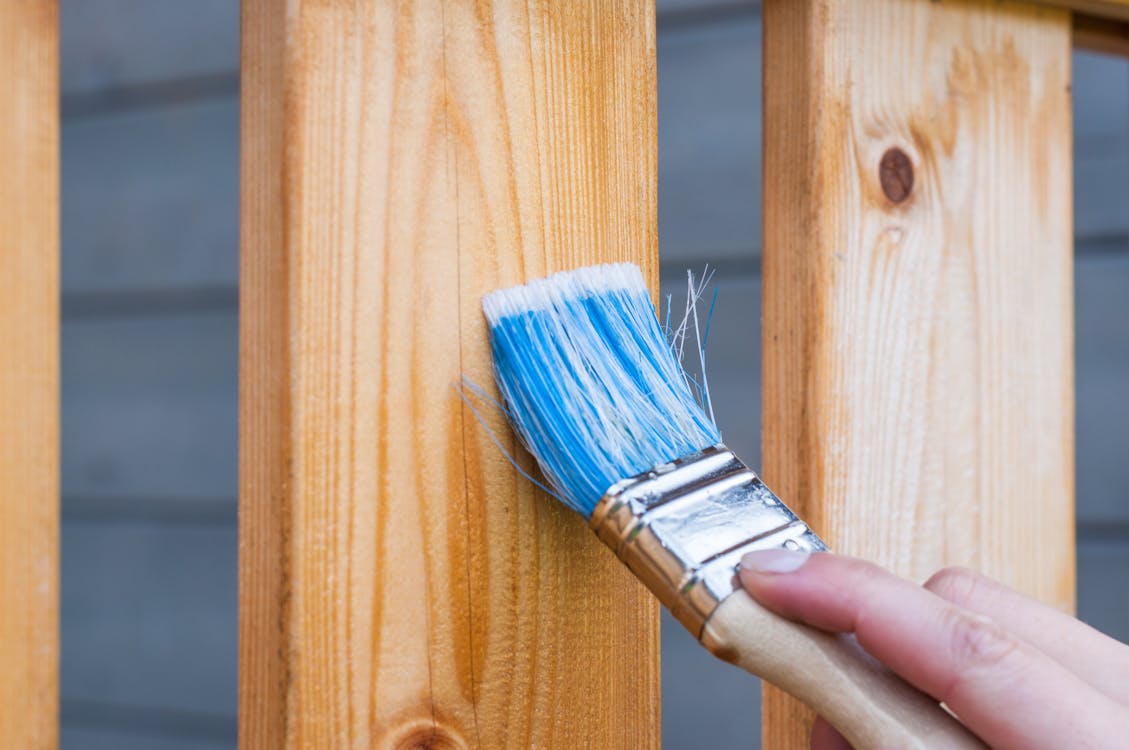
Most deck stains call for two coats. Apply the first coat and let it penetrate for 15–30 minutes, then wipe away any excess that pools on the surface before it becomes tacky. Apply the second coat after the manufacturer's recommended recoat window — typically 2–4 hours for water-based products and 4–8 hours for oil-based.
A brush or roller works for most decks; a pad applicator is popular for flat boards because it gets into the gaps between boards. Spray application can cover large areas quickly but requires masking and careful technique to avoid overspray on siding and railings. Most professionals use a combination: sprayer for the field, brush for edges and railings.
Let the final coat cure for a full 24–48 hours before light foot traffic, and 72 hours before moving furniture back onto the deck. Don't stain if rain is in the forecast within 24 hours.
How Long Does Stain Last?
The honest answer depends on the product type, your exposure, and how well the prep was done:
- Clear finishes: Reapply annually — they just don't hold up long under Midwest sun and weather cycles.
- Semi-transparent stains: 2–3 years under typical conditions. Heavy sun exposure or a deck that stays wet (heavy tree cover, shaded north-facing) can shorten this.
- Solid-color stains: 3–5 years with proper prep and application.
Time is not the only indicator. Use the water bead test year-round — if water stops beading, protection has failed regardless of how recently you stained. Signs you need to restain now: fading or chalking color, visible cracking or peeling, gray weathering returning, water soaking in on contact, or any visible mold growth.

DIY vs. Hiring a Pro
This is genuinely a reasonable DIY project for many homeowners, but not for all decks or all situations.
DIY makes sense when: The deck is in good overall condition, no major repairs are needed, you have a clear 2-day weather window, and the deck is under 400 square feet. A homeowner can complete a 300 sq ft deck — including power washing, drying time, and two coats of stain — in a weekend. Materials cost $200–$400 depending on deck size and product selection.
Hire a pro when: The deck needs significant repairs before staining. The existing finish is a solid stain or paint that needs to be stripped (stripping is labor-intensive and unpleasant — pros have the right equipment). The deck is elevated or two-story (safety). The deck is large (500+ sq ft) and your time is limited. Established suburban decks in Dublin, Ohio or Livonia, Michigan that haven't been treated in 5+ years almost always benefit from professional prep.
DIY time estimate: 1–2 days for a 300–400 sq ft deck including all prep and two stain coats. A hired crew typically completes the same scope in 1–2 days as well — the value you're buying is expertise, equipment, and your time back.

What This Costs in the Midwest
Urban vs. Suburban vs. Rural
Professional deck staining runs $2–$4 per square foot nationally for labor plus materials. For a typical 300–400 sq ft deck, that's $600–$1,600 for a full-service job. Midwest markets fall across a range within that band:
| Markets | Estimated Range (300–400 sq ft deck) | Notes |
|---|---|---|
| Chicago metro, Detroit metro | $900 – $1,800 | Higher labor rates; union density in Chicago adds 15–30% vs. open-shop markets; Detroit's older housing stock often drives higher prep scope |
| Columbus, Milwaukee, Grand Rapids, Cleveland | $700 – $1,400 | Near national average; competitive open-shop labor markets; Columbus suburban decks trend larger, pushing total project costs up |
| Rural Indiana, rural Ohio, rural Michigan | $600 – $1,100 (where available) | Fewer specialty contractors; deck staining often bundled with painting crews; lead times 4–8 weeks vs. 1–3 weeks in suburban markets; DIY is common and practical |
Suburban homeowners in Naperville, IL, Dublin, OH, and Livonia, MI should budget at the higher end of their market's range — not because suburban contractors charge more per square foot, but because suburban decks are physically larger. A new build in Dublin or Naperville often has a 500–600 sq ft deck. At the same per-sq-ft rate, that job costs 50–75% more than a 300 sq ft urban deck. Getting three quotes in these markets regularly produces a $400–$600 spread on the same job — it's worth the calls.
In rural areas outside the metro rings in Indiana, Ohio, and Michigan, expect fewer competing quotes and longer scheduling lead times. Materials from Menards, Farm & Fleet, or local hardware stores are readily accessible, making DIY more practical and common in these markets.
Local Factors That Affect Your Quote
Freeze-thaw cycle damage scope — especially in Cleveland, Detroit, and Milwaukee: The Great Lakes region experiences more freeze-thaw cycles per winter than most of the country. Each cycle forces water into wood fibers, expands, and causes micro-cracking. Decks in Cleveland and Detroit — particularly pre-2000s construction — accumulate this damage over decades. Contractors in these markets often discover boards that need replacement before staining begins, adding $150–$600+ to the project scope. Newer suburban builds in Columbus (Dublin, Westerville) and Indianapolis suburbs (Carmel, Fishers) typically have younger, less damaged decks and lower prep requirements.
Humid summers accelerating mildew: The Ohio River Valley and Great Lakes basin summers are genuinely humid — not just warm, but persistently wet. Columbus and Milwaukee both see significant summer humidity that accelerates mildew growth on shaded or north-facing decks. Homeowners in wooded suburban lots (common in Dublin, OH and Brookfield, WI) should specifically look for stain products with mildewcide additives, and may need to budget for a mildew treatment step during prep if the deck surface shows dark staining.
Pressure-treated pine dominance across Midwest housing stock: Most Midwest decks are built with pressure-treated yellow pine rather than cedar or redwood. PT pine weathers differently — it grays faster, requires longer cure time when new, and often benefits from a wood brightener step before staining. Contractors unfamiliar with PT-dominant markets may quote based on cedar deck experience and underestimate the prep needed. Ask specifically whether the quote includes a brightener step.
Spring demand surge and booking timing: In most Midwest markets, May and June represent the bulk of annual deck staining demand. Unlike southern markets where the staining season stretches 16+ weeks, Midwest contractors face a compressed spring window of just 6–8 weeks before summer heat and humidity complicate application conditions — so schedules fill fast. Contractors in Columbus, Milwaukee, and Grand Rapids regularly fill their spring calendars by mid-April. Booking in March or early April typically yields better scheduling flexibility than waiting until the first warm week of May. If you're reading this in April, call now.

Frequently Asked Questions
- Can I stain over old stain?
- Yes, with conditions. Semi-transparent over semi-transparent generally works if the existing stain has faded but is not peeling. Solid over solid works. You cannot successfully apply semi-transparent over solid — the old solid finish blocks penetration. When in doubt, strip first.
- How long does the whole project take?
- For a DIY homeowner: allow a full day for prep and washing, 48 hours for drying, and a day for staining — spread across a long weekend. A professional crew typically completes prep and staining in 1–2 days of on-site work, but scheduling lead times in spring are 2–4 weeks in most markets.
- What if it rains right after I stain?
- Most stains need 24 hours to cure before rain exposure. Water hitting uncured stain can cause blotching, streaking, or washing-away of the product. Check the extended forecast before you start — you want 48 clear hours from the start of staining.
- Do I need to seal after staining?
- Not if you're using a combination stain-and-sealer product, which is the most common residential choice. If you use a pure pigmented stain with no sealer built in, a separate clear sealer coat adds water repellency and UV protection. Read the product label — it will specify.

Get Your Deck Ready the Right Way
A properly stained and sealed deck adds years of life to the wood, protects your investment, and makes the space actually enjoyable from May through October. The difference between a deck that looks great at year three and one that's peeling by fall comes down to prep, timing, and the right product for your specific wood condition.
If you're in Columbus, Milwaukee, Grand Rapids, Detroit, or anywhere across the Midwest and you'd rather have it done right the first time, Saorr connects you with vetted local contractors who know Midwest wood, Midwest weather, and what your deck actually needs this spring. No guesswork, no searching blind — just a clear quote from someone who's done this work in your market.
Get a free estimate from a Saorr-vetted contractor near you →

Find Trusted Pros Near You
Ready to start your project? Connect with vetted, top-rated contractors in your area.
Get Started