Landscape & Pathway Lighting Installation
Landscape & Pathway Lighting Installation: What It Really Costs in 2026
You've walked your driveway in the dark one too many times. Maybe you've tripped on a step, or watched a guest squint at your front door trying to figure out where to ring the bell. Good landscape and pathway lighting fixes all of that - it improves safety, boosts curb appeal, and adds enough visual warmth that your home actually looks finished after sunset.
The catch? Pricing is all over the map. A homeowner in Indianapolis might pay $2,200 for a solid 12-fixture low-voltage system. That same job in San Francisco could run $6,000. A basic solar stake kit from a big-box store runs under $100, but it'll also look like a basic solar stake kit from a big-box store.
This guide breaks down what landscape and pathway lighting installation actually costs in 2026 - by region, by system type, and by who's doing the work. Whether you're planning to hire out or tackle it yourself, here's what you need to know before you spend a dollar.
What You're Actually Buying: System Types Explained
Before anyone gives you a quote, you need to know which type of system you're dealing with. The two categories don't just differ in price - they differ in who's legally allowed to install them.
Low-Voltage (12V) Systems
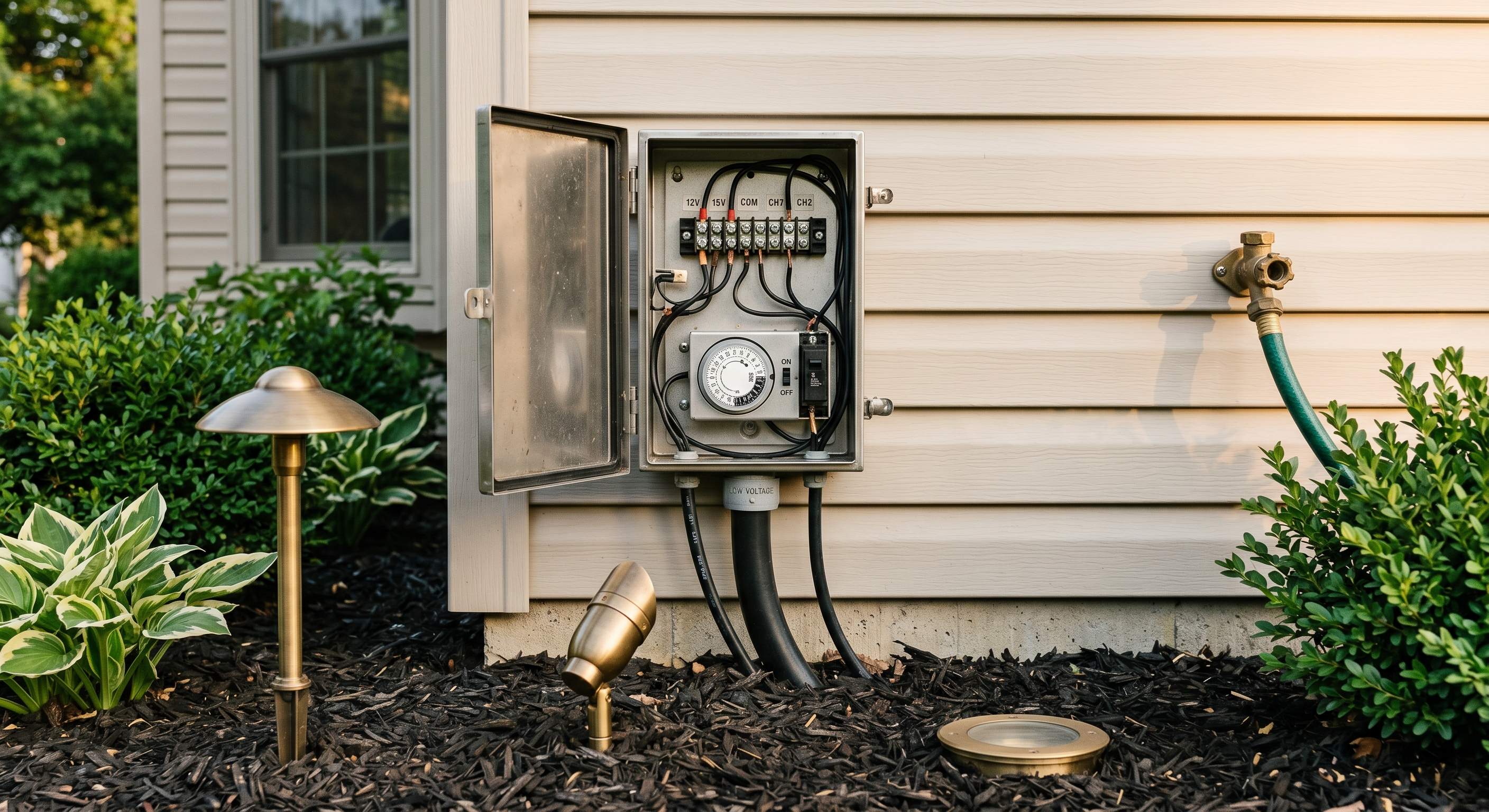
This is the most common residential choice, and the one most homeowners picture when they think of pathway lighting. A transformer plugs into your outdoor outlet and steps down the current from 120V to 12V. Wire runs connect your fixtures - path lights, spotlights, uplights - through the mulch and garden beds. Safe, DIY-legal in most states, and easy to expand.
A typical 10-15 fixture low-voltage system runs $2,500-$4,500 professionally installed, or $150-$400 in materials if you do it yourself. This is the national average baseline most homeowners should plan around.
Line-Voltage (120V) Systems
High-output fixtures, in-ground well lights, hardwired post lanterns, security floods - these run on full 120V power. They require a licensed electrician in every state, buried conduit, and usually a permit. Expect $300-$600 per fixture installed, plus permitting fees. Not the right choice for a simple pathway job, but necessary for serious security lighting or large custom systems.
Smart and Hybrid Systems
Wi-Fi-controlled transformers, color-temperature adjustment, zone timers, app-based scheduling - smart landscape lighting has gotten genuinely good in recent years. Brands like Lutron, CAST, and FX Luminaire offer systems that let you manage every zone from your phone. Add $300-$1,500 to a standard low-voltage install depending on the hub and feature set.
What Landscape & Pathway Lighting Installation Costs Across the US
Labor is the biggest variable in any landscape lighting quote. The difference between what a licensed electrician charges in Boston versus what a lighting specialist charges in Oklahoma City is not subtle - we're talking 40-70% swings in hourly rate. Here's what real installs cost in each region for a typical 10-15 fixture low-voltage system.

Northeast - Maine, New Hampshire, Vermont, Massachusetts, Rhode Island, Connecticut, New York, New Jersey
Boston, New York City: $3,500-$8,500
Hartford, Providence, Albany: $2,800-$6,500
The Northeast is the most expensive region in the country for this work. Massachusetts construction wages average $48.90/hour - the highest nationally - and New York clocks in at $44.90/hour (NAHB/BLS, 2024). Union labor is prevalent in Boston and NYC metro areas, which adds another 15-30% on top of base electrician rates for any line-voltage work. Frost lines run 5–6+ feet deep in northern New England (Maine, Vermont, and New Hampshire require 60–74 inch minimum foundation depths), meaning any buried conduit requires serious deep trenching that adds real labor time and cost. Southern New England (Connecticut, Massachusetts, Rhode Island) is more moderate at 3–4 feet. In many Connecticut and New York towns, permits and inspections are required even for low-voltage systems - budget an extra $150-$400 for that process.
Mid-Atlantic - Pennsylvania, Maryland, DC, Virginia, West Virginia, Delaware
Washington DC / Northern Virginia, Baltimore: $3,000-$7,000
Pittsburgh, Richmond: $2,200-$5,500
DC and Northern Virginia are high-cost-of-living markets with competitive contractor demand - federal government employment keeps wages elevated across the board, and suburban Maryland and Virginia homeowners tend to run larger systems with 15-25 fixtures across bigger lots. Baltimore is similar but slightly more competitive. Pittsburgh runs near the national average, with AHE around $37-40/hour, keeping pricing reasonable. Richmond is a right-to-work market with non-union competition that keeps rates in check - Henrico and Chesterfield County are active suburban markets with plenty of quoting options.
Southeast - North Carolina, South Carolina, Georgia, Florida, Alabama, Mississippi, Tennessee, Arkansas, Kentucky
Atlanta, Miami, Charlotte, Nashville: $2,000-$5,000
Raleigh, Tampa, Nashville suburbs: $1,800-$4,500
The Southeast is generally the most affordable region for landscape lighting, driven by right-to-work labor laws and lower construction wages - South Carolina averages $31.30/hour, Florida $31.40/hour (NAHB/BLS, 2024). The one exception is Miami, where luxury real estate demand pushes contractor rates toward Mid-Atlantic levels; budget $60-$90/hour for a Miami-area specialist. The best time to schedule in most of the Southeast is October through April - spring heat and summer thunderstorms make outdoor installation miserable and push scheduling out. Clay soils in Georgia and the Carolinas actually save money on trenching compared to rocky Northeast terrain.
Midwest - Ohio, Indiana, Illinois, Michigan, Wisconsin, Minnesota, Iowa, Missouri, and the Plains
Chicago, Detroit, Minneapolis: $2,800-$6,500
Indianapolis, Columbus, Milwaukee: $2,000-$4,500
Chicago leads the Midwest in cost - Illinois construction wages average $44.90/hour (tied with New York for 5th nationally), and Cook County union density means licensed electricians on line-voltage work often run $85-$120/hour. Most suburban landscape lighting still goes to non-union landscape specialists, keeping residential pricing more manageable, but Chicago is still firmly T1 in cost. Indianapolis, Columbus, and Milwaukee all track near the national average and represent some of the best value markets in the country for quality work at reasonable prices. The Midwest installation window is compressed - May through September - so spring backlog is real; expect 4-6 week lead times in April and May.
South & Gulf Coast - Texas, Oklahoma, Louisiana, Arkansas, Mississippi
Houston, Dallas/Fort Worth: $2,000-$5,000
San Antonio, Austin, Oklahoma City: $1,700-$4,500
Texas runs one of the most competitive contractor markets in the country - large pool of providers, right-to-work labor laws, and construction AHE in the $34-38/hour range. DFW is particularly dense with landscape contractors, which keeps pricing honest even in premium suburban markets like Frisco and The Woodlands. Austin is an exception: tech-boom wage inflation has pushed landscape contractor rates to $60-$80/hour, above the Texas average and approaching national midpoints. Oklahoma City and the rest of OK run on AHE around $32/hour, making them some of the most affordable markets in the US. Summer scheduling is brutal at 95-105°F - target February through April or October through November for best availability and pricing.
Mountain West - Colorado, Utah, Nevada, Arizona, New Mexico, Idaho, Wyoming, Montana
Denver, Phoenix: $2,200-$5,500
Salt Lake City, Boise, Albuquerque: $1,800-$4,500
Phoenix is a year-round outdoor living market, and landscape lighting is a major industry there - Scottsdale and Paradise Valley run large custom systems, keeping the contractor ecosystem robust and pricing competitive relative to the scope. Denver sits near the national average on labor, with a strong suburban market in Highlands Ranch and Parker. Salt Lake City is a market worth watching: Utah saw 8%+ construction wage growth in 2024, one of the fastest rates nationally, and wait times are extending as demand outpaces contractor supply. Phoenix installs need to plan around extreme summer heat - transformer placement is critical on south-facing walls where ambient temps can hit 140°F+ and void manufacturer warranties.
Pacific Coast - California, Oregon, Washington, Alaska, Hawaii
Seattle, Los Angeles, San Francisco Bay Area: $3,500-$9,000
Portland, San Diego, Sacramento: $2,800-$7,000
The Pacific Coast is the most expensive region in the country, full stop. Washington State construction wages average $47.30/hour (2nd nationally), California $44.10/hour, and Oregon $43.00/hour - all in the top nine nationally. Bay Area contractor rates run $100-$150/hour; permit fees alone can add $200-$500 to a project in San Jose or San Francisco. Sacramento is 25-35% below Bay Area pricing and represents the best value on the Pacific Coast; Portland runs 15-20% below Seattle.
What Pushes the Price Up (or Down)
The regional data above gives you a realistic range, but within any given market the actual quote you get depends heavily on a handful of job-specific variables. Know these before you call anyone.

Fixture Count
This is the most predictive variable. Each added fixture adds roughly $100-$300 installed for low-voltage and $300-$600 for line-voltage hardwired. A 6-fixture path job and a 20-fixture system with uplighting and zone control are not in the same universe cost-wise - get clarity on scope before comparing quotes.
Fixture Quality
Brass and copper fixtures run $80-$200 each and last decades. Good aluminum runs $30-$80. Composite and plastic entry-level fixtures are $10-$30 but degrade fast under UV exposure and freeze-thaw cycles. Don't let a low-bid contractor swap your spec to cheap plastic without telling you - verify fixture material in any written quote.
Wiring and Trenching
Surface-run wire through mulch costs almost nothing extra. Buried conduit through clay, compacted soil, or around existing hardscape adds $3-$8 per linear foot of trench. Rocky soil (New England, Texas Hill Country, Mountain West) can double that number. A 150-foot conduit run in Phoenix caliche is a very different job than a 150-foot run in Georgia red clay.
Transformer and Controls
A basic transformer runs $40-$80. A quality unit with dual zones, timers, and a photocell runs $150-$300. A smart transformer with Wi-Fi app control, color temperature adjustment, and multiple zones runs $300-$600. Don't buy the cheapest transformer - it's the brain of the whole system, and it will fail first if it's undersized or underfeatured.
Permits and Inspections
Most low-voltage systems don't require a permit. Some jurisdictions - California, New York City, Chicago, much of Florida - require permits even for 12V systems or impose stricter documentation. Budget $0-$500 depending on location; ask your contractor what's required before they pull any wire.
DIY vs. Hiring a Pro: The Real Tradeoffs
Low-voltage landscape lighting is genuinely one of the more approachable DIY electrical projects out there. No license required in most states. No high-voltage risk. A motivated homeowner can install a quality 8-10 fixture system in a weekend and save $1,000-$2,500 in labor. Here's the honest breakdown of when it makes sense and when it doesn't.

DIY Makes Sense When:
- You're installing a low-voltage (12V) system - no electrical license required in most US jurisdictions
- Your scope is 6-15 path lights and a transformer - straightforward enough that most manufacturer kits walk you through it
- You're comfortable with basic outdoor wiring: connecting transformer to circuit, running wire through mulch, making watertight fixture connections
- You have an existing outdoor GFCI outlet near where the transformer will mount
- You're not dealing with buried conduit, hardscape cutting, or panel upgrades
Materials for a DIY 8-10 fixture low-voltage system: $150-$400 at any home center. Time investment: 4-6 hours for a first-timer. That's a legitimate $1,000-$2,000 labor savings in most markets.
Hire a Pro When:
- Line-voltage (120V) work: Any hardwired fixture, in-ground well light with buried conduit, or new circuit from your panel requires a licensed electrician - period, everywhere in the US
- Panel capacity: If your outdoor circuits are already maxed, you need an electrician to add capacity safely
- Large or custom systems: 20+ fixtures, multiple zones, smart controls, and tree uplighting involve transformer sizing math and load balancing that's easy to get wrong; an undersized transformer will fail within a year
- Design matters: Landscape lighting specialists - not general electricians - understand beam angles, layering, and fixture placement. There's a real difference between a lighting designer and someone who can pull wire.
The Hybrid Approach
Worth mentioning: many homeowners buy the fixtures and wire themselves, then hire an electrician just to add a dedicated outdoor circuit and mount the transformer properly. That hybrid approach often costs $300-$600 in electrician fees and keeps total project cost well under $1,500 even for a quality 12-fixture system.
How to Hire the Right Landscape Lighting Contractor
Not every electrician does landscape lighting. And not every landscaper understands electrical load. The best landscape lighting contractors sit at the intersection of both - they know fixture design, transformer sizing, and the local code requirements for outdoor systems. Here's how to find and vet one.

Who to Look For
Search for landscape lighting specialists or outdoor lighting designers rather than general electricians. Many operate under a landscape contractor's license and do all their own low-voltage work legally. For any line-voltage portions, confirm they either hold or subcontract a licensed electrician - ask directly.
Good indicators of a quality contractor: they use named fixture brands (FX Luminaire, VOLT, Kichler, Vista Professional), they offer a written design plan before install, and they size the transformer based on your actual wattage load rather than just "it'll be fine."
What to Ask Before You Sign Anything
- Do you pull permits? A reputable contractor knows what your municipality requires and handles it. If they tell you "we never pull permits" for line-voltage work, walk away.
- What brand and gauge wire are you using? 14-gauge direct burial wire is the industry standard for low-voltage runs. For longer runs (100+ feet) or higher wattage loads, step up to 12-gauge. 16-gauge can cause voltage drop issues on longer circuits — your lights at the far end will run dim.
- What happens in year two? Ask about warranty terms and what a fixture replacement costs. Contractors who sell you cheap composite fixtures and disappear aren't doing you any favors.
- Is this design or installation only? Some contractors charge separately for a lighting design plan; others include it. Knowing which you're paying for matters.
- Can I see a recent local project? Not a portfolio photo - an actual job site or current client reference you can call.
Getting Multiple Quotes
In most markets, get three quotes. The spread on landscape lighting is wider than almost any other home service - it's not unusual to see a $1,500 spread between the low and high bidder on the same 12-fixture job. That spread isn't always about quality; sometimes it's just margin. Compare fixture specs, wire gauge, transformer brand, and warranty terms alongside the price number.
Timing Matters
In most of the country, spring is the single busiest time for landscape contractors. April and May mean 4-6 week lead times in markets like Chicago, Minneapolis, Boston, and Denver. If you book in February or early March - or wait until September - you're likely to get better scheduling, sometimes better pricing, and more attention from a crew that isn't running six jobs simultaneously.
What a Finished System Looks Like - and What to Verify
When the job is done, there are a handful of things worth checking before you write the final check.

Walk the Whole System After Dark
This sounds obvious, but do it. Walk every fixture location and verify: fixtures are aimed correctly (uplights angling toward the intended feature, path lights casting even pools of light), no fixtures are tilted from backfill settling, and no dark spots exist between fixtures. Any good contractor will do a night walkthrough with you - if they want to leave before it's dark, ask them to stay.
Check the Voltage at the Far End
Voltage drop is the silent killer of landscape lighting systems. A properly sized transformer and correctly wired circuit maintains 10.8-12V at every fixture. If the last fixture on a long run is getting 9V, it'll run dim and the LED module will age faster. Your contractor should measure and document voltage at the transformer and at the end of each wire run.
Understand the Timer and Photocell Setup
Make sure you know how to adjust the timer and what the photocell sensitivity is set to. A lot of homeowners spend six months with their lights turning on at 4 PM because nobody showed them the transformer controls. It's a five-minute walkthrough - make sure it happens.
Energy Savings Are Real
A properly designed LED landscape lighting system uses 75-80% less power than an equivalent halogen system. For a 15-fixture setup running 6 hours a night, that's real money over time - typically $30-$70/year in electricity depending on your rate and system size. LED fixtures also last 25,000-50,000 hours versus 2,000-4,000 for halogen, which means you're not buying replacement bulbs every two seasons.
Many utilities offer rebates for Energy Star certified outdoor LED fixtures. Check the Energy Star rebate finder at energystar.gov before you finalize your fixture spec - rebates of $10-$30 per fixture are common through Pacific Gas & Electric, Xcel Energy, ComEd, Duke Energy, and others. On a 15-fixture system, that's up to $450 back in some service territories.
Bottom Line: What Should You Budget?
| Markets | Typical Range | Notes |
|---|---|---|
| NYC, SF Bay Area, Boston, Seattle | $4,500-$9,000 | High COL, union labor density, permit costs |
| Chicago, DC/NoVA, Los Angeles, Portland | $3,000-$7,000 | Above national average; strong seasonal demand |
| Denver, Phoenix, Atlanta, Charlotte, Dallas, Houston | $2,200-$5,500 | Near national average; competitive contractor markets |
| Indianapolis, Columbus, San Antonio, Salt Lake City, Raleigh, Tampa | $1,800-$4,500 | National average; best value for quality pro installs |
| Oklahoma City, Pittsburgh, Boise, most rural markets | $1,500-$4,000 | Below national average; competitive non-union markets |
For most homeowners, a professionally installed 10-15 fixture low-voltage LED system is a $2,500-$4,500 project at the national average - and worth every dollar compared to another year of tripping over your own front step in the dark. If budget is tight, the DIY low-voltage route genuinely works: buy a quality kit, use 12-gauge wire, don't cheap out on the transformer, and you can get there for $200-$400 in materials.

Either way, your yard looks better at night than it did yesterday. That's the job.
Ready to Get Quotes?
Landscape lighting quotes vary more than almost any other home service. The only way to know what your specific project costs is to talk to local contractors who've actually worked in your neighborhood, with your soil type, and under your local code requirements.
Use Saorr to get matched with vetted landscape lighting specialists in your area - contractors who know the difference between a properly sized transformer and a ticking time bomb, and who'll give you a written quote you can actually compare. Get your free estimates today.
Find Trusted Pros Near You
Ready to start your project? Connect with vetted, top-rated contractors in your area.
Get Started