
Dryer Vent Cleaning: The One Safety Job Indianapolis & Chicago Homeowners Keep Ignoring (And Why Spring Is the Time to Fix That)
You know that thing behind your dryer? The duct that runs from the back of the machine to the outside wall? There's a good chance you've never thought about it. And there's an even better chance it's packed with lint right now.
That's not a knock on you. Most homeowners don't think about dryer vents until something goes wrong. The problem is, when something goes wrong with a dryer vent, it can go very wrong very fast.
You just came through a winter where your dryer ran hard - heavy blankets, thick socks, sweatshirts, jeans that take forever to dry. All of that fabric pushed maximum lint through your vent system. It's sitting in there right now, dry and flammable, waiting for the right conditions.
Spring is your window. The weather's cooperating, contractors are available, and you still have time to deal with this before it deals with you. This guide covers everything you need to know about dryer vent cleaning - the risks, the signs, the cost, and how to hire someone who isn't going to rip you off.
Let's get into it.
The Numbers Are Alarming - Here's What a Clogged Dryer Vent Actually Does

Dryer fires cause roughly 15,000 residential fires per year in the United States - and the leading cause is failure to clean.
The U.S. fire departments respond to roughly 15,970 residential dryer and washing machine fires every year. Of those, 92% start in the dryer - that's approximately 14,700 dryer fires annually.
The damage adds up to about $200 million in property losses per year. Around 30 people die and 400 more are injured in these fires annually. These aren't industrial accidents. They're happening in homes like yours.
Here's the part that should get your attention: failure to clean is the #1 cause, responsible for 33-34% of all dryer fires. Not faulty wiring. Not manufacturing defects. Lint that nobody bothered to clear out.
And if you have an electric dryer, pay close attention - electric dryers are 2.5 times more likely to cause fires than gas dryers. More electric resistance = more heat = more risk when airflow is restricted. A clogged vent doesn't let that heat escape. It has to go somewhere.
Beyond the fire risk, a clogged vent makes your dryer work harder than it needs to. That extra effort shows up on your utility bill. A restricted vent can cost you roughly $20 a month extra in electricity. Over a year, that's $240 - more than what a professional cleaning would have cost you.
Why Spring Is the Single Best Time to Clean Your Dryer Vent

By end of winter, your dryer vent has accumulated months of the heaviest possible lint buildup of the year.
Dryer vents need to be cleaned at least once a year. If you're going to pick one time of year to do it, spring is the right call - and not just because the weather's nice.
Think about what your dryer processed all winter. Heavy blankets. Fleece. Multiple layers of everything. Winter fabrics shed significantly more lint than summer clothes. By the time March rolls around, your dryer vent has hit its annual peak for buildup. Right now is when it's most restricted - and most dangerous.
Spring also gives you a practical advantage: contractor availability is better. The summer HVAC rush hasn't kicked in yet. You're not competing with everyone else who suddenly realized their AC isn't working. You can usually get an appointment within a few days, at a normal price, without anyone trying to upsell you because they're booked solid.
Waiting until fall to deal with this isn't a neutral decision. You're running your dryer through the spring and summer with a vent that's already compromised. Every load adds a little more restriction. Every cycle runs a little hotter. The longer you wait, the more you're paying in electricity and the closer you're pushing toward an actual problem.
Do it now. You'll thank yourself come December.
8 Signs Your Dryer Vent Is Telling You Something's Wrong

Taking two or more cycles to dry a single load is one of the most common early warning signs of a clogged dryer vent.
Your dryer vent doesn't have a warning light. But it does send signals. Here's what to watch for:
- Clothes are taking more than one cycle to dry. This is the most common sign. If a normal load used to dry in 45 minutes and now it takes an hour and a half, airflow is restricted.
- Clothes come out hotter than usual. When heat can't escape through the vent, it stays in the drum. Clothes that are unusually hot at the end of a cycle mean the exhaust isn't clearing.
- The laundry room feels humid or stuffy when the dryer runs. That moisture has to go somewhere. If the vent is blocked, it's going into your room instead of outside.
- You can smell burning. This is not the sign to wait on. A burning smell during a dryer cycle means lint is getting hot enough to smolder. Stop using the dryer and call a pro today.
- The outside vent flap isn't opening when the dryer runs. Go outside while your dryer is running. The exterior damper should open and you should feel warm air moving through. If it's barely moving or staying shut, the vent is obstructed.
- It's been more than a year since you cleaned it. Even if you don't have obvious symptoms, if you can't remember the last time it was serviced, it's overdue.
- You have pets or a large family. More people and more pets means more laundry, more fabric, more lint. High-volume households should be cleaning twice as often.
- Lint is visible around the dryer connection or outside vent. If you can see lint building up at the connection point or escaping around the exterior damper, the vent is overwhelmed.
If you're hitting two or more of these, stop second-guessing it. Get the vent cleaned.
"33% of all dryer fires are caused by one thing: failure to clean. The fix costs $115–$200 and takes 60 minutes."
DIY or Pro? Here's How to Make the Right Call
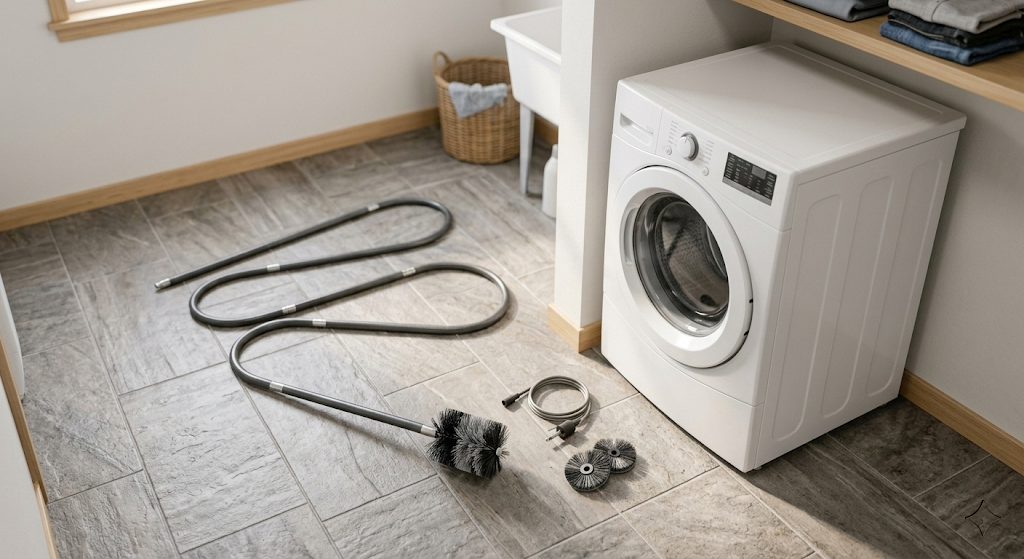
DIY brush kits include flexible rod segments and bristle heads that attach to a drill — effective for short, straight vents, but no match for long runs, bends, or bird nests.
There's a DIY dryer vent brush kit at most hardware stores for $20-$30. It's a legitimate tool and for the right setup, it does the job. Here's how to know if that's you.
When DIY Makes Sense
If your dryer vent runs in a short, straight line - say, the dryer is on an exterior wall and the vent is 5 feet of rigid duct going straight out - a brush kit and 30 minutes is a reasonable solution. Pull out the dryer, disconnect the duct, run the brush through, reconnect, done.
You should be comfortable pulling the dryer away from the wall and disconnecting the duct at the back. If that sounds like a problem, just call someone.
When You Need a Pro
- Long duct runs. If your dryer is more than 10-15 feet from the exterior exit, a hand brush isn't going to cut it. Pros have rotary equipment that can reach and clean the full length.
- Multiple bends or elbows. Every turn in the duct is a lint trap. More bends mean more places the brush won't reach.
- You smell burning. Don't DIY this one. A burning smell means there's already heat buildup. You need someone with a camera to assess what's in there before you start pushing lint around.
- Bird nests or animal blockages. More common than people think. Exterior vent dampers are prime real estate for birds in spring. A nest in your vent is not a brush kit situation.
- Roof exits. If your dryer vents through the roof rather than a side wall, this is a professional job. Full stop.
- You've never had it done. If this is your first cleaning in several years, start with a pro. Get a baseline on the condition of the duct, and then maintain from there.
What Does a Professional Dryer Vent Cleaning Actually Include?
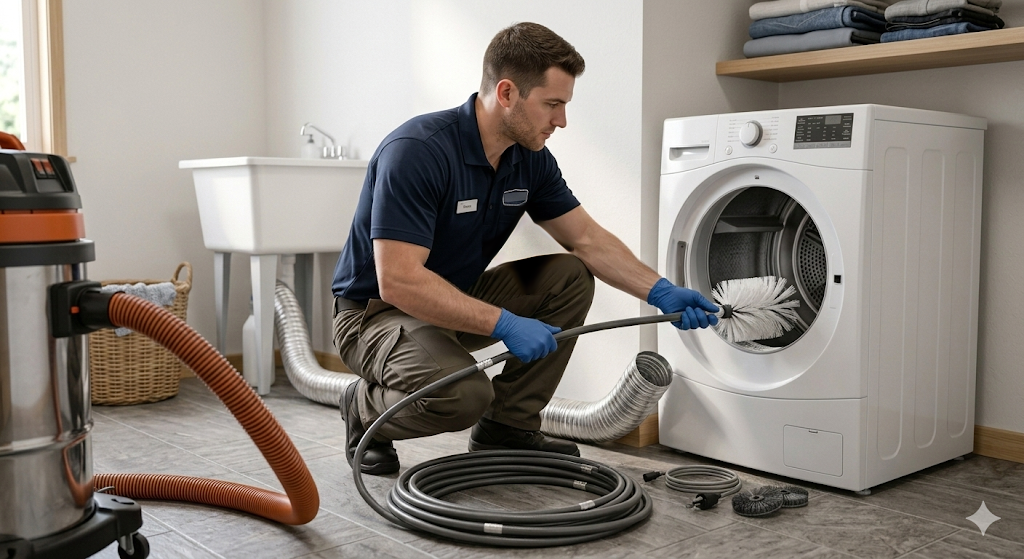
A professional cleaning includes rotary brush cleaning, commercial vacuuming, and a final airflow test — all in about 60 minutes.
A standard professional dryer vent cleaning takes about 60 minutes. Here's what a legitimate service includes:
- Disconnecting the dryer and accessing the full duct run from the machine to the exterior exit
- Using a rotary brush system (not just a hand brush) to break up and clear compacted lint throughout the entire duct
- High-powered vacuuming to pull the debris out rather than just pushing it further in or out into your laundry room
- Inspecting the exterior damper to confirm it opens and closes properly
- Checking the duct for kinks, damage, or improper materials (flexible plastic duct is a fire hazard and should be replaced with rigid metal)
- Reconnecting the dryer and doing a functional test to confirm airflow is restored
On cost: in Indianapolis, a standard cleaning runs $115–$200. In Chicago, expect $130-$225 for a standard job. If you've got a complex situation - roof exit, a bird nest, a very long run, or serious buildup - the price can climb: in Indianapolis, complex jobs typically run $200-$400; in Chicago, expect $250-$450. That's real money, but compare it to a house fire or a new dryer.
If you're getting quoted significantly under that range, read the next section carefully.
How Often Should You Clean?

Annual cleaning is the minimum. Families of four or more, pet owners, and heavy laundry users should aim for every six months.
The baseline answer is once a year, minimum. That applies to most households. But "most households" covers a lot of ground, and your situation may call for more frequent cleaning.
- Single person or couple, no pets: Once a year is fine. Spring is the right time.
- Family of 4 or more: Every 6 months. You're running significantly more laundry cycles, which means significantly more lint. Annual cleaning won't keep up.
- Pet owners (especially heavy shedders): Every 6 months. Pet hair moves through laundry and accumulates in vents faster than you'd expect.
- Households that air-dry rarely or never: More dryer use = more lint = more frequent cleaning needed.
- Anyone with a long or complex duct run: More frequent inspections are worth it. Lint accumulates faster in longer runs and at every bend.
- Anyone who noticed warning signs above: Don't wait for your scheduled cleaning. Get it done now.
A simple rule: if you're doing more than 5-6 loads of laundry per week, you should be on a twice-yearly schedule.
How to Hire Someone You Can Actually Trust

A reputable dryer vent cleaner will always provide a written estimate, show credentials, and explain what they'll do before starting.
This is the part most guides skip, and it's where homeowners get burned - sometimes literally, but usually financially.
What to Look For
The credential to ask about is NADCA certification - specifically ASCS (Air Systems Cleaning Specialist) or CVI (Certified Ventilation Inspector). NADCA is the Air Duct Cleaning Association, and their certifications mean the technician has passed training and testing specific to duct and vent systems. It's not the only marker of quality, but it's the clearest one.
Ask contractors these questions before you book:
- Are your technicians NADCA certified?
- Do you use a rotary brush system with vacuum extraction, or just compressed air?
- Will you inspect the exterior damper and duct material condition?
- Do you do a post-cleaning airflow test?
- Can you provide a written estimate before the job starts?
A contractor who can answer those questions clearly and confidently is probably the real deal. One who hedges or changes the subject probably isn't.
Red Flags to Walk Away From
- The $49 whole-house special. This is a bait-and-switch. The low price gets a technician in your door, and then they find "problems" that require expensive add-ons. The final bill looks nothing like the ad. A legitimate dryer vent cleaning alone costs $100+. If the whole house is $49, something's off.
- No written estimate. Any reputable contractor will tell you the price before they start. If they won't, walk away.
- High-pressure upselling. A photo of scary-looking duct debris with a $600 "critical remediation" quote attached is a classic move. Get a second opinion before agreeing to anything that wasn't in the original scope.
- No verifiable reviews or business presence. Check Google reviews. Check the BBB. If the company has no track record you can verify independently, that's a risk.
Where to find legitimate pros: Google reviews with photos, Angi, and Nextdoor recommendations from neighbors who've used them recently. Word of mouth from people in your actual neighborhood is worth more than any ad.

A licensed, insured dryer vent cleaning technician arrives with the right equipment — rotary brushes, commercial vacuum, and everything needed to clear your vent and confirm airflow in about 60 minutes.
Spring Is Your Window - Don't Let It Close
You now know more about dryer vents than 90% of homeowners. More importantly, you know what to do about it.
Your dryer ran hard all winter. The buildup is at its peak. The weather is cooperating, contractors are available, and a $115–$200 service call is a straightforward trade for peace of mind and a dryer that actually works right.
If you're in Indianapolis or the Chicago area and want this handled by people who know what they're doing, Saorr connects you with vetted local home service pros - the kind who show up on time, do the job right, and don't try to sell you something you don't need. Book your dryer vent cleaning this spring before the calendar fills up and the risk keeps building.
Get it done. Your future self will appreciate it.
Find Trusted Pros Near You
Ready to start your project? Connect with vetted, top-rated contractors in your area.
Get StartedRelated Articles

Spring Pest Control 2026: When to Spray, What to Watch For, and Why March Is Already Too Late to Wait

Spring Sprinkler Startup: What Irrigation Contractors Find Wrong Every Year (And What It Costs You)