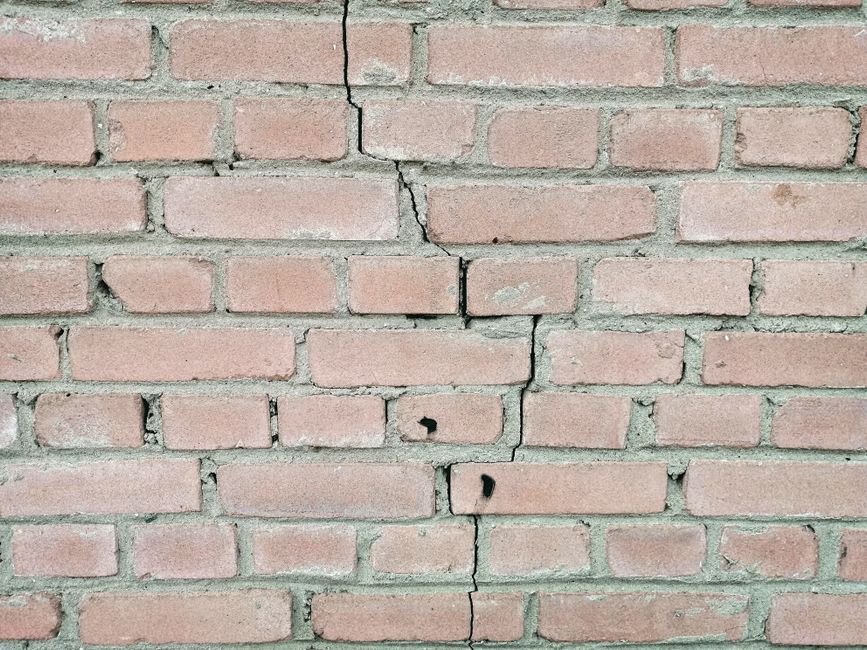
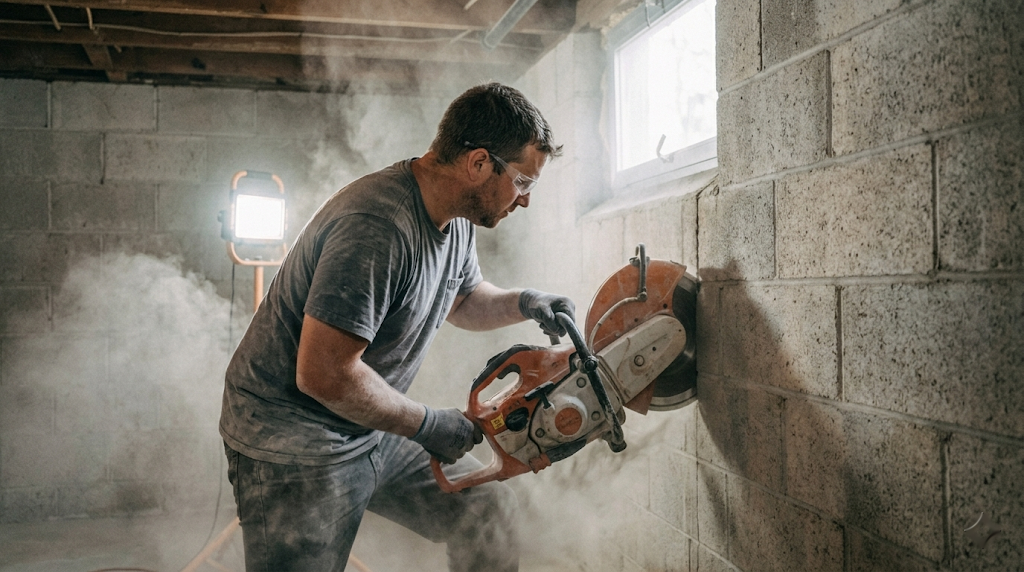
Egress Window Installation Guide — Midwest 2026
Egress Window Installation Guide for Midwest Homeowners (2026)
That basement bedroom your listing calls a "4th bedroom"? If it doesn't have a code-compliant egress window, it's legally a storage room - and a buyer's agent will catch it. Worse, if someone's sleeping down there and a fire breaks out, that window might be the only way out. This isn't a technicality. It's safety and money, tied together in one $2,600-$5,900 project.
This guide covers everything you need to know before you cut a single block: IRC code minimums, real cost breakdowns, the block-vs.-poured-wall question that trips up most older Midwest homes, window well drainage in clay soil, what you can realistically DIY, and what the permit process actually looks like across the Great Lakes region. Whether you're finishing a basement in Columbus, adding a legal bedroom in a Chicago bungalow, or converting a Detroit two-flat, here's what you're dealing with.
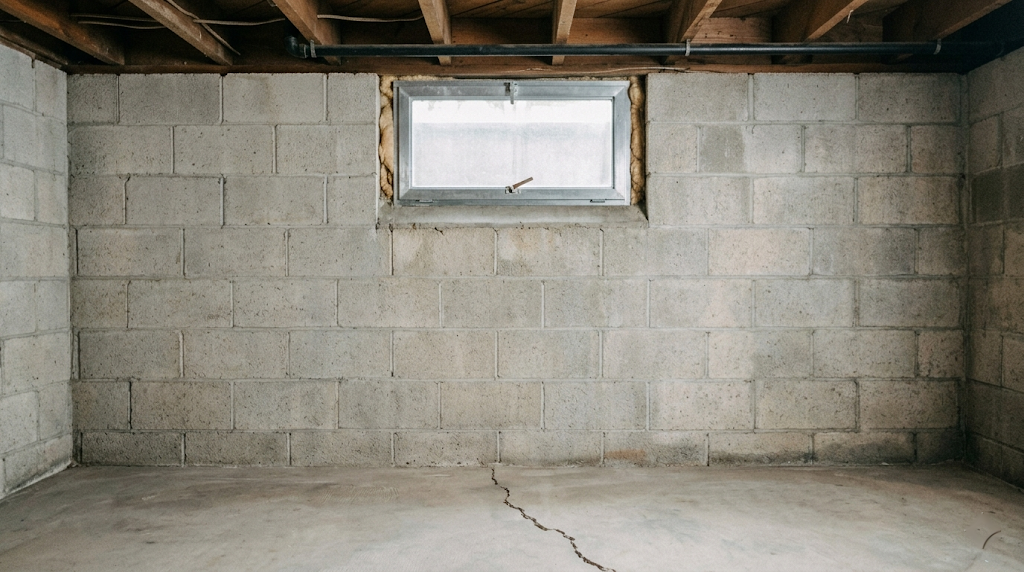
What the IRC Actually Requires (and What Midwest States Do With It)

Before any egress window goes in, the IRC sets the floor: 24" minimum height, 20" minimum width, 5.0 sq ft net opening area for below-grade spaces.
The International Residential Code (IRC) Section R310 sets the floor for egress window requirements. Every sleeping room in a basement needs at least one operable emergency escape and rescue opening - and so does every basement, full stop, even if nobody's sleeping down there.
Here's what "code-compliant" means in actual numbers:
- Net opening height: 24 inches minimum
- Net opening width: 20 inches minimum
- Net opening area (below grade): 5.0 sq ft minimum
- Net opening area (above grade): 5.7 sq ft minimum
- Maximum sill height from finished floor: 44 inches
- Window well clearance: 9 sq ft minimum (at least 36 inches out from the house)
- Window well ladder: Required if the well depth exceeds 44 inches
"Net opening" means the clear space when the window is fully open - not the rough opening in the wall, not the frame size on the product sheet. A casement window that cranks fully open is the most popular choice for egress precisely because it gives you 100% of its opening area. Single-hung and sliding windows only open halfway, so you need a unit that's twice as tall or wide to hit the same net area.
Indiana: IRC 2018 adopted statewide (effective 2020). Consistent and predictable. Every sleeping room and every general basement space needs an egress opening.
Ohio: Ohio Residential Code is IRC-based with state amendments. Columbus, Cleveland, Cincinnati, and Dayton all follow the ORC — egress requirements are the same as IRC R310. Local building departments enforce permits, so timelines vary by municipality.
Michigan: Michigan Residential Code is IRC-based. Detroit, Grand Rapids, Lansing, and Ann Arbor all operate under the same state code with local enforcement. Older Detroit housing stock (pre-1960 brick two-flats and bungalows) is heavily CMU — expect block-wall complexity and cost premiums.
Wisconsin: Wisconsin Uniform Dwelling Code (UDC) governs one- and two-family homes statewide. Milwaukee follows the UDC; commercial and multi-unit buildings follow a different path. Egress minimums align with IRC R310.
Illinois / Chicago: Illinois has not adopted a statewide residential code — municipalities handle it. Chicago follows the Chicago Building Code (CBC), IBC-based rather than IRC. The egress minimums are similar, but enforcement is strictly local. Chicago-specific: window bars and security grilles must be releasable from the inside. Suburban Cook County and collar counties (Naperville, Aurora, Joliet) generally adopt IRC with local amendments. Always verify with your local building department.
Minnesota: Minnesota Residential Code is IRC-based. Minneapolis and St. Paul follow state code with local permit processes. Frost depth is significant here (42–48 inches in the Twin Cities) — drainage and frost protection requirements are more stringent than southern Midwest markets.
If your basement bedroom doesn't meet these numbers, you cannot legally list it as a bedroom on the MLS. That knocks your appraised value and cuts your buyer pool.
What This Project Actually Costs in 2026

The foundation cut is where most of the project cost lives. Diamond-blade saws and skilled labor aren't cheap - and they shouldn't be.
National average for a below-grade egress window installation runs $2,600-$5,900, with most projects landing around $4,100-$4,200. Here's where the money goes:
- Window unit (prefab): $100-$500 | Custom: $500-$700
- Foundation wall cut + well excavation: $1,500-$3,000
- Installation labor: $40-$100/hour
- Permits: $50-$500 (typically $150-$300)
- Structural engineer (if required): $350-$1,000
The window itself is the cheap part. You're paying for everything around it - the concrete cutting, excavation, header installation, drainage, and backfill. If someone quotes you $5,500–$6,000 in a major Midwest metro, that's not a rip-off. It might actually be fair.
Window type matters for cost:
- Single-hung: ~$397/unit
- Double-hung: ~$495/unit
- Sliding: ~$507/unit
- Casement (most common for egress): ~$560/unit
Frame material also moves the needle - vinyl runs $100-$850, aluminum $150-$1,250, fiberglass $200-$1,500, wood $400-$2,000. For a basement egress application, vinyl is the practical choice for most Midwest homeowners: moisture-resistant, low maintenance, and affordable.
What you'll pay by market:
| Markets | Typical Project Cost | Notes |
|---|---|---|
| Chicago (city proper), Detroit metro, Minneapolis / St. Paul | $4,500–$7,000+ | Union labor premium, higher permit costs, older block-heavy housing stock drives complexity |
| Indianapolis, Columbus OH, Cleveland OH, Cincinnati OH, Milwaukee WI, Grand Rapids MI | $3,200–$5,500 | Near or slightly above national average; competitive contractor markets |
| Chicago suburbs (Naperville, Aurora, Joliet), Indy suburbs (Carmel, Fishers), Ann Arbor MI | $3,500–$5,800 | Lower than city-core rates but high new-construction demand keeps scheduling tight |
| Rural Indiana, rural Ohio, Michigan U.P. | $3,000–$5,000 + travel | Fewer licensed contractors; travel charges of $25–$75/trip common; 2–4 week lead times typical |
BLS May 2023: Indianapolis-Carmel-Anderson MSA construction mean wage $30.16/hr (national avg $29.57). Chicago union trades run 15–30% above national average.
Block Wall vs. Poured Concrete: The Question That Changes Everything
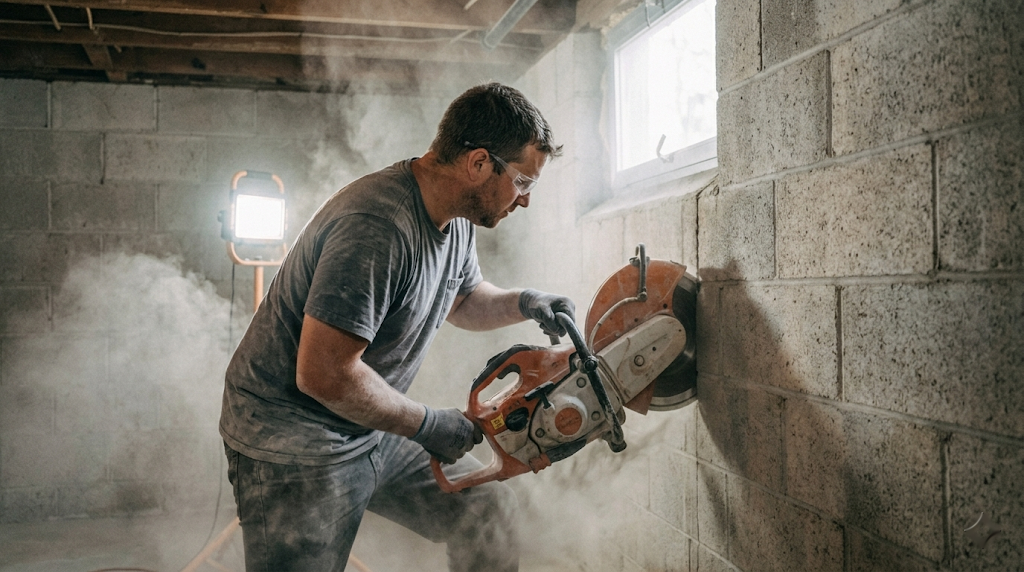
If your home was built before 1970 - which describes a huge portion of the housing stock in Indianapolis, Chicago, Detroit, Cleveland, Columbus, and Milwaukee - there's a good chance your basement walls are concrete block (CMU), not poured concrete. This one difference affects your cost, your timeline, and who you hire.
Poured concrete walls (common in post-1970s builds):
- Cut with a diamond-blade concrete saw or core drill
- One continuous cut - predictable, relatively clean
- Cutting alone: $400-$800 if you hire it out
- Structural header installation is more straightforward
Concrete block / CMU walls (pre-1970s bungalows, ranches, and colonials across Indianapolis, Chicago, Detroit, Cleveland, and Columbus):
- Cutting is more complex - you're working with block courses, not a continuous pour
- Must preserve block integrity above the opening; improperly cut blocks crack
- Header installation is more involved (and more critical)
- Older block walls are often 12 inches thick vs. 8-10 inches for poured concrete
- Tools: angle grinder with diamond blade or hammer drill and chisel
- Add $300-$600 to your project estimate compared to poured concrete, depending on wall thickness and contractor
When you're calling contractors for quotes, tell them upfront what your walls are. Any contractor who doesn't ask before quoting is either assuming poured or not paying attention - either way, your quote will be wrong.
Not sure which you have? Go to the basement, look at the wall. Poured concrete is smooth and monolithic (you might see form lines). Block walls show courses of rectangular masonry units - usually 8"×8"×16" or 8"×12"×16". Pretty hard to miss once you're looking.
Window Well Sizing, Drainage, and the Midwest Clay Problem
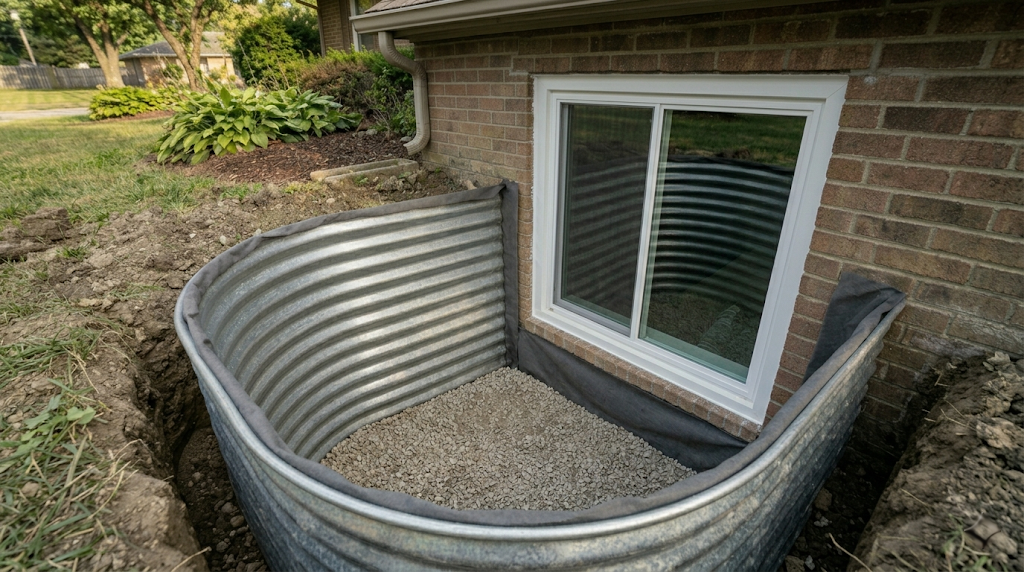
Corrugated galvanized steel window well with angular gravel drainage and geotextile liner — the right way to handle Midwest clay soil that stays saturated all spring.
The window well is where a lot of DIY egress projects fall apart - specifically, water management in Midwest clay soil.
Code minimums for the well: 9 square feet of clear area, at least 36 inches of clearance from the house wall. If the well is deeper than 44 inches, you need a ladder or steps built into it. But code minimums are just the floor. Across most of the Midwest, soil conditions and the freeze/thaw cycle demand more thought than the minimum.
The clay problem: Indianapolis, Chicago, Columbus, Cleveland, Detroit, and Milwaukee all sit on heavy clay soils. Clay expands when it absorbs water and freezes solid in winter, putting serious lateral pressure on your window well walls. If your well doesn't drain correctly, you get:
- Hydrostatic pressure against the foundation wall
- Ice forming in the well and cracking the retaining walls
- Water infiltrating the window frame and into the basement
- Spring flooding when thaw hits saturated soil
Drainage done right:
- Use 3/4" clean angular rock (not pea gravel) as backfill - angular rock nests together and stays in place; round gravel migrates
- Line behind the retaining walls with geotextile fabric to keep clay from migrating into the drain rock
- Connect the well drain to your interior drain tile / sump system - many Midwest municipalities require this, not just recommend it
- Install a window well cover - across the Midwest, snow load and spring debris will fill an uncovered well fast
Frost depth matters too: Frost depth varies across the region — Indianapolis and Columbus run around 24–30 inches, Cleveland and Detroit push 36–40 inches, and Chicago, Milwaukee, and Minneapolis hit 42–48 inches due to Great Lakes influence. When you're digging a window well near or below frost depth, you need 2-inch rigid insulation (25-psi rated) at the footing to prevent frost heave from working against the foundation. The deeper your market's frost line, the more critical this step is.
Best time to install: late spring (May-June) or early fall (September-October). Ground is workable, not saturated from snowmelt, not frozen solid. If you're finishing your basement in January and just realized you need egress, plan the exterior work for spring.
DIY vs. Hiring a Pro: Where the Line Actually Falls

A rented mini excavator ($450/day) makes DIY window well excavation viable. Hand-digging through Midwest clay is a different story entirely.
Family Handyman rates egress window installation as "Advanced." That's accurate. But "advanced" doesn't mean "hire out everything" - it means knowing where your skills end and structural risk begins.
What almost always requires a professional:
- Foundation wall cut: This is the non-negotiable. One wrong cut in a load-bearing wall and you've got a structural problem that costs 10x the window project to fix. Concrete saws and core drills are rentable, but skill and structural knowledge aren't.
- Header installation: The header carries the floor load above the opening. Getting this wrong has consequences you'll feel in the floor joists upstairs.
- Permit pull: Many jurisdictions require a licensed contractor to pull the permit for foundation work. Verify locally.
- Well drain connection to sump/tile: Requires waterproofing expertise and often plumbing knowledge.
- Engineer's stamp: If your well is deep enough to require it, a structural engineer signs off. That's not a DIY deliverable.
What a skilled DIYer can handle:
- Excavation: Rent a mini excavator for about $450/day - absolutely worth it versus hand-digging in clay. Most rental yards will walk you through the controls in 15 minutes.
- Building or setting the window well retaining wall: Prefab galvanized steel wells or timber-framed wells are manageable with basic carpentry skills.
- Insulation, fabric lining, rock backfill: Straightforward if you understand the drainage logic.
- Window installation in an already-cut opening: If the opening is ready and properly sized, installing a prefab window is within reach for an experienced DIYer.
- Grading and landscaping restoration: Finish work you can own completely.
The practical split: Hire a pro for the cut, header, and permit. DIY the excavation and well construction. You'll save $500-$800 and still walk away with a compliant, professionally cut opening. That's the move most experienced basement finishers make.
Permits and Inspections: What to Expect

The permit fee ($150-$300 in most Indiana and Illinois municipalities) is the cheapest insurance in this entire project. Don't skip it.
There's no version of this project where you skip the permit. You're cutting through a foundation wall. Every jurisdiction that has building codes requires a permit for that - and nearly all of them do.
What you're typically pulling:
- Building permit: Required everywhere. Covers the structural work.
- Excavation permit: Required if you're digging below grade (you are).
- Engineer's stamped drawings: Required in some jurisdictions when well depth or wall conditions warrant it.
Timeline: Budget 2-4 weeks for permit processing. Don't schedule your contractor before you have the permit in hand - or at least confirmation that it's approved.
Inspections happen at minimum twice: once after the rough opening is cut and the header is installed (before the window goes in), and once at final completion. Your inspector will measure the net opening, check sill height, verify the well dimensions, and look at your drainage setup. In many Midwest municipalities, they'll also confirm the well drain ties into the sump or drain tile system.
Skipping the permit is how you create a problem at resale. Unpermitted egress work comes up in buyer inspections, triggers title issues, and can void homeowner's insurance claims if there's a fire or structural event. The permit fee ($150-$300 in most Indiana and Illinois municipalities) is the cheapest insurance in this whole project.
Midwest Market Realities in 2026
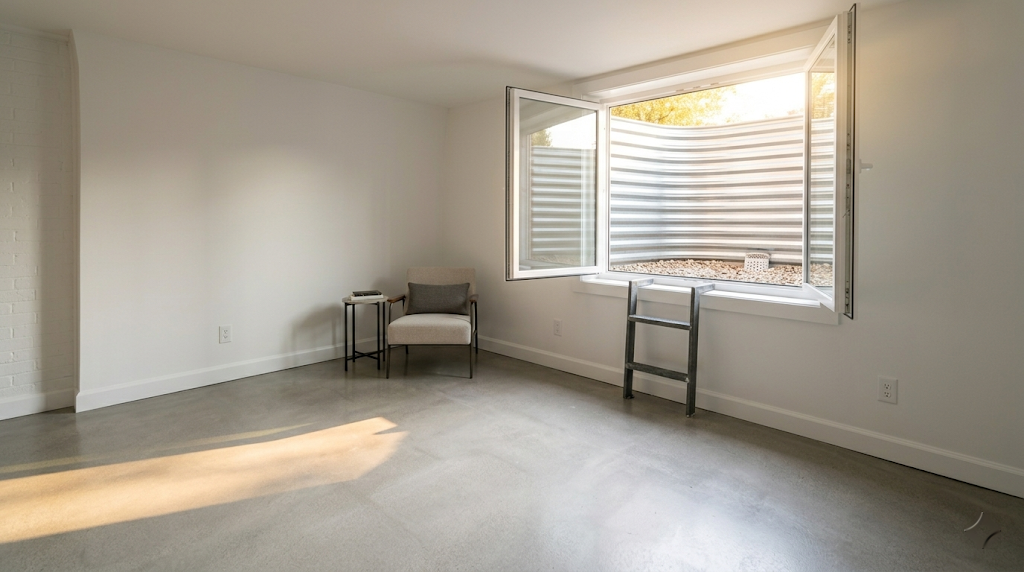
The same project plays out differently depending on where you are in the region.
Indianapolis / Central Indiana:
- IRC 2018 — consistent and predictable statewide
- Permit timelines vary by municipality (Indianapolis, Carmel, Fishers, Greenwood all have separate offices), but code is the same
- Total project cost typically $3,500–$5,500; wages slightly above national average
- Mix of newer poured concrete (post-1980s suburbs) and older block foundations (pre-1970s Southside, Eastside, Broad Ripple)
- Frost depth ~30 inches — drainage matters, but heave risk is lower than northern markets
Columbus / Cleveland / Cincinnati (Ohio):
- Ohio Residential Code is IRC-based — straightforward permit process through local building departments
- Columbus is a competitive contractor market; total costs typically $3,200–$5,000
- Cleveland's older housing stock (pre-1960 brick and CMU) adds complexity — expect block-wall premiums
- Frost depth: Columbus ~24 inches, Cleveland ~36–40 inches — drainage requirements increase as you go north
- Strong demand for legal egress in Cleveland and Columbus near university and rental districts
Detroit / Grand Rapids / Ann Arbor (Michigan):
- Michigan Residential Code is IRC-based; permits pulled through local municipality
- Detroit's pre-1960 housing stock is heavily block foundation — CMU complexity is the norm, not the exception
- Union labor presence in Detroit drives costs toward $4,500–$6,500 for full installs
- Grand Rapids and Ann Arbor are more competitive — expect $3,500–$5,500
- Frost depth 36–42 inches across southern Michigan — frost protection at the footing is not optional
Milwaukee / Madison (Wisconsin):
- Wisconsin UDC governs one- and two-family homes statewide — IRC-aligned egress requirements
- Milwaukee's older housing stock is comparable to Chicago's near-north side — brick and block from the early 1900s
- Total costs typically $3,500–$5,500; lower union density than Chicago keeps prices competitive
- Frost depth ~42 inches — same Lake Michigan influence as Chicago
Chicago / Northeast Illinois:
- Chicago CBC (IBC-based), not IRC — always verify with the local building department before assuming anything
- Naperville, Aurora, and Joliet follow IRC with local amendments; always confirm before you pull a permit
- Union labor premium: 15–30% above national average; Chicago proper projects often $5,000–$7,000+
- Pre-1960 bungalows and two-flats are heavily block foundation — adds cost and complexity
- Frost depth ~42 inches — frost protection at the footing is non-negotiable
- Chicago specifically: window bars/grilles must be operable from the inside
- High density of basement apartments creates strong demand for compliant egress — and strong inspection scrutiny
Across all these markets, the math is the same: a code-compliant egress window converts a "bonus room" into a legal bedroom. That bedroom adds directly to appraised value and opens up conforming rental income. The egress window pays back.
FAQ

The right contractor answers your questions before the bid, not after. Ask about wall type, permit pulling, and header design upfront.
What happens if I sell my house without a compliant egress window in the basement bedroom?
Your real estate agent has to list it as a "bonus room" or "flex room" instead of a bedroom. That directly cuts your appraised value and your asking price - buyers and appraisers both count bedrooms. Some buyers won't look at a 3-bedroom listing when they need 4. If you've already listed it as a bedroom without egress, you're looking at a potential disclosure issue and possible deal-killer during inspection.
Can I install an egress window in a block wall myself?
The excavation and well construction - yes. The foundation cut in a block wall - this is where most experienced contractors draw the line even for themselves. Block walls require clean cuts that preserve course integrity and a properly sized, correctly installed header. An incorrect cut in a CMU wall can crack adjacent blocks and compromise the wall above the opening. If you're set on DIYing, at minimum get a structural engineer to review your plan and have a contractor cut the opening while you handle everything else.
My window well keeps filling with water every spring. Is that a drainage problem or a window problem?
Almost certainly drainage. Most recurring water intrusion around egress wells in the Midwest comes from one of three things: no drain connection (well fills up and eventually seeps through or around the window frame), drain connection that's blocked or disconnected from the sump system, or clay soil migration that's clogged the drain rock over time. The fix usually involves excavating around the well, installing or cleaning out the drain, adding geotextile fabric, and repacking with angular rock. It's not a glamorous project but it's the actual solution - not caulking the window frame.

Experienced hands, the right tools, and a permit in hand - that's what a clean egress installation looks like.
Ready to Get This Done? Talk to Saorr.
Egress window installation is one of those projects where the difference between a clean job and a nightmare is almost entirely about who's doing it. The foundation cut, the header, the drain connection - every one of those steps has a right way and a wrong way, and the wrong way shows up at the worst possible moment.
Saorr works with homeowners across Indiana, Ohio, Illinois, Michigan, and Wisconsin who need egress windows done correctly - permitted, inspected, and built to last. Whether your basement has block walls or poured concrete, whether you're in Columbus or the Chicago suburbs, we'll walk through the project with you from permit to final inspection.
Get a straight answer on what your project actually costs. No ballpark guesses, no surprises after the foundation's already cut.
Request a free egress window estimate from Saorr →

Permitted. Inspected. Built to last through Midwest freeze/thaw cycles. That's the Saorr standard.
Find Trusted Pros Near You
Ready to start your project? Connect with vetted, top-rated contractors in your area.
Get Started