Spring Pressure Washing Guide for Indianapolis and Chicago Homeowners (2026 Pricing + What NOT to Wash)
Take a good look at your house from the street. Not a glance — actually stop and look. After five months of Indianapolis or Chicago winter, what you're seeing isn't just dirt. It's road salt baked into your driveway. It's mold that's been quietly colonizing your north-facing siding since November. It's a winter's worth of exhaust, freeze-thaw grime, and oxidation sitting on surfaces that are supposed to last decades. Spring is when you deal with it — or spend the next five years watching it eat your paint, your deck, and your concrete.
This guide covers what actually needs to be washed, what you can handle yourself, what it costs to hire someone in Indianapolis and Chicago, and how to avoid hiring someone who makes it worse. Let's get into it.
Why Your House Needs a Wash After a Midwest Winter
Midwest winters don't just get things dirty. They set the conditions for damage that continues long after the snow is gone.
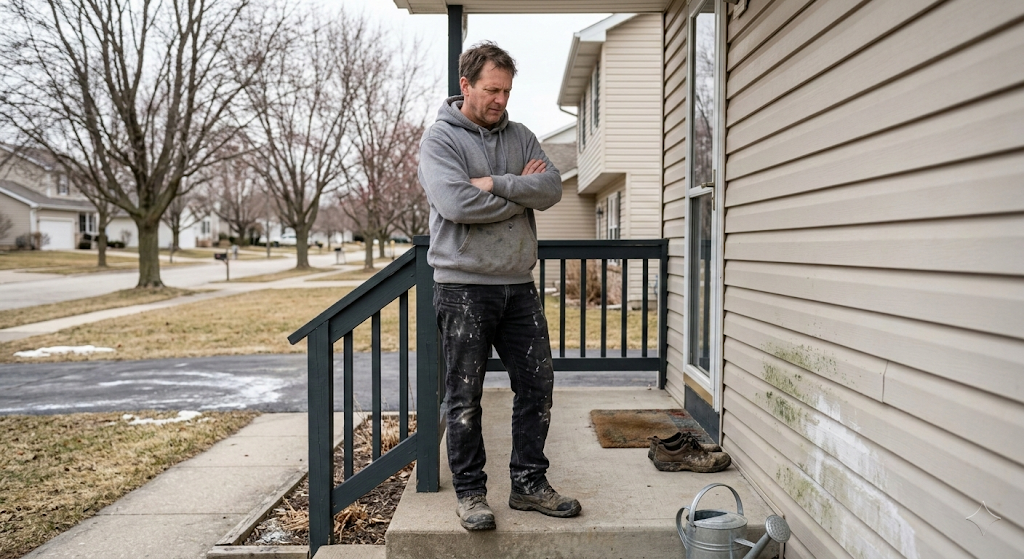
Road salt is the one most people don't think about. From November through February, every passing car and city truck sprays salt-laden slush onto your driveway, sidewalks, porch steps, and the lower two feet of your siding. Salt is hygroscopic — it pulls moisture from the air and keeps concrete and masonry wet longer than it should be. Left on concrete through spring, it accelerates pitting and spalling. Left on siding, it degrades the surface finish and holds moisture against the substrate.
Mold and mildew grow slowly under snow cover, then detonate once temperatures push past 50°F in March and April. North-facing walls and shaded surfaces are the worst — they stay damp longer and get less UV. What looks like a little discoloration in March can be a full green layer by June that's started penetrating the wood or paint. Once it's in the substrate, it's not coming off with a garden hose.
Freeze-thaw cycling does the structural work. Organic debris — leaves, soil, mold spores — packs into every crack and joint over winter. Water freezes and expands, driving it deeper. By March, what was a hairline crack in your deck boards or driveway surface has been opened up and loaded with material that holds moisture every time it rains.
And if you're planning to paint or stain anything this spring, stop right there. Pressure washing is Step 1 — full stop. Paint applied over dirty, mold-contaminated, or chalky siding will fail early regardless of how good the paint is. A properly cleaned surface can extend an exterior paint job from 4–5 years to 7–10 years, according to The Spruce (April 2024). Painters know this. Most homeowners learn it the hard way.
What to Pressure Wash (and What NOT to Touch)
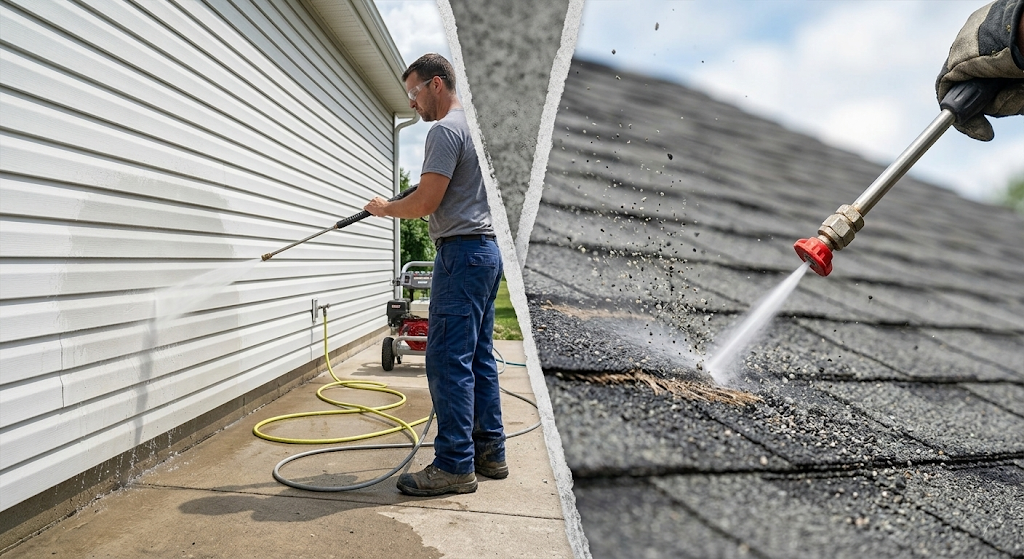
Not everything on your house wants the same treatment. Using the wrong pressure on the wrong surface is how you crack vinyl siding, strip deck stain you just applied last year, or void your shingle warranty before you even know you did it.
| Surface | Method | PSI Range | Notes |
|---|---|---|---|
| Vinyl siding | Soft wash preferred | 500–800 PSI max | High pressure forces water behind panels into wall cavity |
| Brick siding | Pressure wash | 800–1,200 PSI | Avoid mortar joints on older homes |
| Wood siding | Soft wash / low pressure | 500–600 PSI | Too high raises wood grain, strips paint |
| Concrete driveway/walk | High pressure | 2,000–3,000 PSI | Can handle it; surface cleaner attachment recommended |
| Wood deck | Medium pressure | 1,200–1,500 PSI | Fan nozzle, spray with the grain |
| Composite deck | Low-medium pressure | 800–1,200 PSI | Check manufacturer guidelines first |
| Gutters (exterior face) | Medium pressure | 1,000–1,500 PSI | Exterior only — not a substitute for gutter cleaning |
| Roof — asphalt shingles | Soft wash ONLY | 150–300 PSI max | High pressure (1,300–2,800 PSI) destroys shingles, voids warranty (This Old House, Nov 2025) |
What you should not pressure wash at all: windows (watertight risk), rotted wood (water drives deeper into damaged material), old or cracked mortar joints, electrical fixtures and meters, and any painted surface you're not refinishing immediately.
DIY vs. Hiring a Pro — The Honest Breakdown
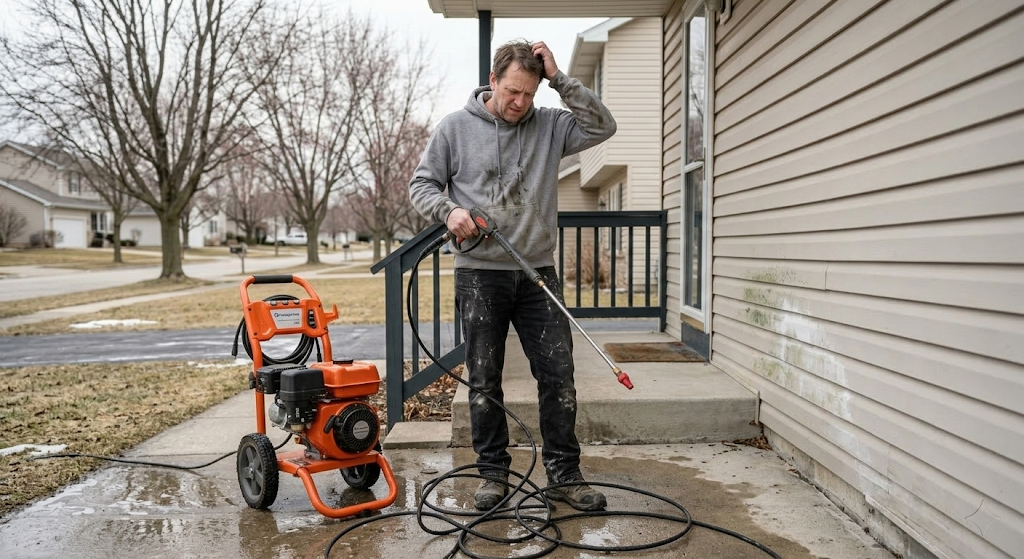
You can DIY this. The question is whether you should — and that depends on which specific surface you're talking about.
What Homeowners Can Handle
Single-story vinyl siding with an electric pressure washer, concrete driveways and sidewalks, ground-level wood decks, and fences at ground level are all reasonable DIY territory. Concrete especially — it's forgiving, it's hard to damage, and the salt removal on your driveway is genuinely satisfying work.
DIY equipment runs $75–$150/day for an electric pressure washer rental and $150–$300/day for a gas unit (Home Depot, Lowe's). Add $15–$40 for house wash detergent and concrete degreaser. Total DIY spend: $100–$350 versus $400–$700 for a pro on a comparable job. The savings are real.
A few rules if you're going at it yourself:
- Use an extension wand (6–12 ft.) for high areas — never combine a ladder with a pressure washer. Recoil at height is how people fall.
- Angle the nozzle, don't point it directly at windows or siding seams — water drives into gaps at high pressure.
- Work top to bottom, rinse top to bottom.
- On vinyl siding, keep the pressure under 800 PSI and use a wide fan nozzle. The number one DIY mistake is cracking or warping vinyl by using too tight a nozzle or standing too close.
When to Call a Pro
Second story or higher — full stop. Multi-story work with a pressure washer on a ladder is a genuine safety risk, and extension wands only get you so far. Also call a pro for: roof cleaning (soft wash requires chemical knowledge and runoff management for landscaping), heavy mold infestations requiring bleach surfactant mixes, any surface you're painting immediately after, and older brick homes where mortar joint judgment matters.
Time is also a legitimate factor. A two-person pro crew finishes a full home exterior in 2–3 hours. A DIYer typically spends 5–8 hours on the same job — and that's if nothing goes sideways.
Need to find a vetted pressure washing pro in Indianapolis or Chicago? Saorr has pre-screened contractors in both markets — licensed, insured, with real homeowner reviews. Worth a look before you commit to a full-day rental.
What It Costs in Indianapolis and Chicago

Here's what you're actually looking at in these two markets, based on 2025–2026 pricing data.
Indianapolis
| Job | Low | Average | High |
|---|---|---|---|
| Full house exterior (1,500–2,000 sq ft) | $400 | $560 | $700 |
| Two-story home | — | $710 | — |
| Driveway only (~600 sq ft) | $100 | $150 | $250 |
| Deck/patio (200–400 sq ft) | $100 | $175 | $260 |
| Full package (house + drive + deck) | $600 | $850 | $1,200 |
Sources: HomeBlue Indianapolis market data; Homewyse national benchmarks
Indiana runs below national averages — roughly $0.32/sq ft versus the national benchmark of $0.43–$0.53/sq ft (Homewyse national data). Midwest labor costs are lower. That's good news for Indianapolis homeowners.
Chicago
| Job | Low | Average | High |
|---|---|---|---|
| Full house exterior | $245 | $345 | $450 |
| Larger/multi-story home | $450 | — | $700+ |
| Driveway | $125 | $200 | $300 |
| Deck/patio | $100 | $200 | $300 |
Source: HomeAdvisor/Angi Chicago market data, 2025
Chicago runs slightly lower than Indianapolis on house washing — higher contractor density means more competition. For driveways, the national average for a standard 600 sq ft driveway lands in the $150–$250 range (Homewyse), which lines up with both markets.
On low-ball quotes: If someone quotes you $99 for "whole house" cleaning, that's bait pricing. Either they're upselling once on-site, or they're running consumer-grade equipment that won't touch your mold problem. The pricing ranges above reflect what a legitimate job actually costs.
How to Hire a Pressure Washing Contractor
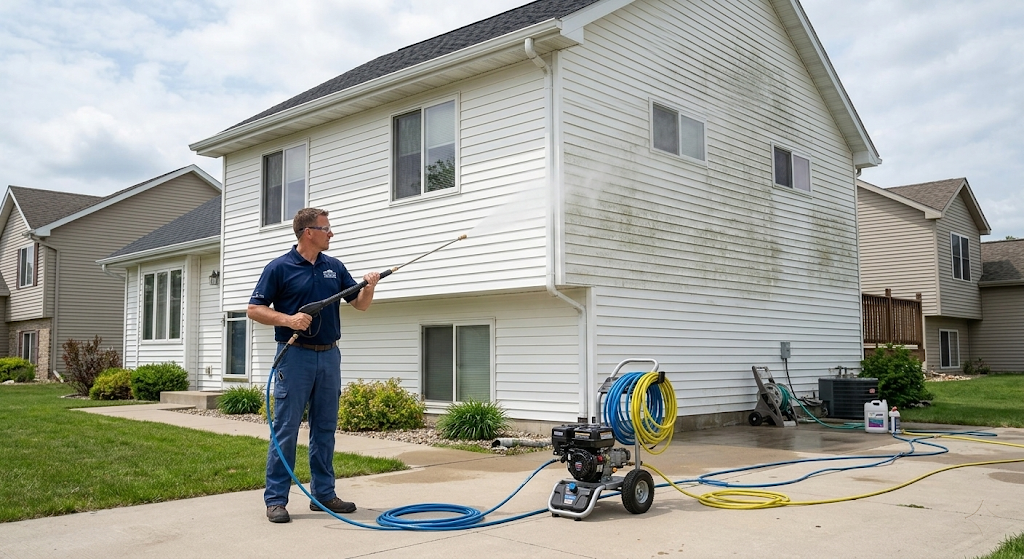
The pressure washing industry has a low barrier to entry. A guy with a $400 consumer pressure washer and a Facebook page can take your money and damage your siding before you know what happened. Here's the six-point checklist to separate the real ones from the rest.
- General liability insurance — minimum $1 million. Ask for a certificate of insurance before work begins. A cracked window, a damaged section of siding, or chemical runoff that kills your landscaping — without coverage, that's your problem. With it, it's theirs. This is non-negotiable (PWNA — Pressure Washing and Restoration Contractors Association, pwna.org).
- Worker's comp if they have employees. An uninsured worker gets hurt on your property and you can be on the hook for medical costs. Solo operators are lower risk; any company with a crew needs to show worker's comp coverage.
- Surface-specific knowledge — ask them. "What PSI do you use on vinyl siding?" The right answer is 500–800 PSI max, or soft wash with detergent. A contractor who says "whatever it takes to get it clean" is telling you they don't think about this. Walk away.
- Soft wash capability. For roof cleaning, algae treatment, and mold-heavy house washing, sodium hypochlorite-based soft wash is the standard. Ask: "Do you offer soft washing?" If the answer is no, they're a one-tool shop.
- Hot vs. cold water equipment. Most residential jobs work fine with cold water. But if you've got oil stains on your concrete from years of car parking, a hot water unit ($3,000–$4,000 commercial grade) makes a real difference. For driveway oil, ask if they use hot water equipment.
- Written quote specifying surfaces, method, and materials. A verbal quote for a vague job is a setup for disagreement. You should know exactly what surfaces are included, what pressure and method will be used, and whether detergents are part of the job.
Green flags: shows up with the right nozzle kit for different surfaces, pre-wets windows before soft washing adjacent siding, rinses landscaping before and after chemical application, uses an extension wand instead of a ladder.
Red flags: quotes without seeing the property, doesn't mention PSI or surface type, offers to pressure wash your roof (a contractor who high-pressures asphalt shingles is voiding your warranty and removing the granules that protect your underlayment — This Old House, Nov 2025), any "$99 whole house special."
Frequently Asked Questions

How often should I pressure wash my house?
Once a year is the standard recommendation for most Midwest homes — and spring is the right time. Homes with heavy tree cover, north-facing walls, or significant mold history may benefit from twice yearly (spring and early fall). Concrete driveways and sidewalks can go every one to two years depending on staining and salt exposure.
What PSI do I need for vinyl siding?
500–800 PSI maximum, with a wide fan (40-degree) nozzle. Better yet, use soft wash — low-pressure detergent application followed by a rinse. High pressure forces water behind the panels and into the wall cavity, where it can cause mold, rot the sheathing, and cause insulation problems you won't find until they're expensive. This is the most common DIY mistake and the main reason vinyl siding jobs often look worse after an amateur wash than before.
Soft wash vs. pressure wash — which do I need?
Pressure wash (high-force water): concrete driveways, sidewalks, brick surfaces, and hardy painted surfaces. Good for removing salt, mud, and physical debris.
Soft wash (low pressure + chemical solution): vinyl and wood siding, roofs, fences, and mold/algae-heavy surfaces. The detergent does the work; the water rinses. It's more effective on biological growth (mold, algae, mildew) than pressure alone because it kills the organism at the root rather than just blasting the visible surface.
How soon after pressure washing can I paint?
You need the surface completely dry — at minimum 24–48 hours in good conditions (low humidity, above 50°F) per most paint manufacturer guidelines. Most professional painters recommend 48–72 hours in Midwest spring conditions, where morning dew and overnight humidity can re-wet surfaces. Don't rush this window. Trapping moisture under paint is a fast way to bubbling, peeling, and an early repaint.
Can I pressure wash my roof?
Not with standard pressure washing equipment. High-pressure water (1,300–2,800 PSI) on asphalt shingles strips granules, damages the mat, and often voids manufacturer warranties (This Old House, Nov 2025). Roof cleaning requires soft wash — a sodium hypochlorite solution applied at 150–300 PSI that kills moss, algae, and lichen without damaging the shingles. This is a professional job.
Ready to Get It Done? Find a Vetted Contractor on Saorr
Spring doesn't wait. The mold is already growing. The salt is already working on your concrete. Every week you push this off is another week of slow degradation on surfaces that cost serious money to repair or replace.
Whether you're doing this before a paint job, before selling, or just because your house deserves better than five months of winter grime, the job is worth doing right. Find a pre-screened, insured pressure washing contractor in Indianapolis or Chicago on Saorr — real homeowner reviews, verified coverage, local pros who know these surfaces and this climate.
Book now while the spring calendar has room. By May, the good ones are already full.
Find Trusted Pros Near You
Ready to start your project? Connect with vetted, top-rated contractors in your area.
Get StartedRelated Articles

Spring Pest Control 2026: When to Spray, What to Watch For, and Why March Is Already Too Late to Wait
Spring Sprinkler Startup: What Irrigation Contractors Find Wrong Every Year (And What It Costs You)