
Standing Water in Your Yard After Every Rain? Here's What It Means and How Much It Costs to Fix in Indianapolis & Chicago (2026)
Standing Water in Your Yard After Every Rain? Here's What It Means and How Much It Costs to Fix in Indianapolis & Chicago (2026)
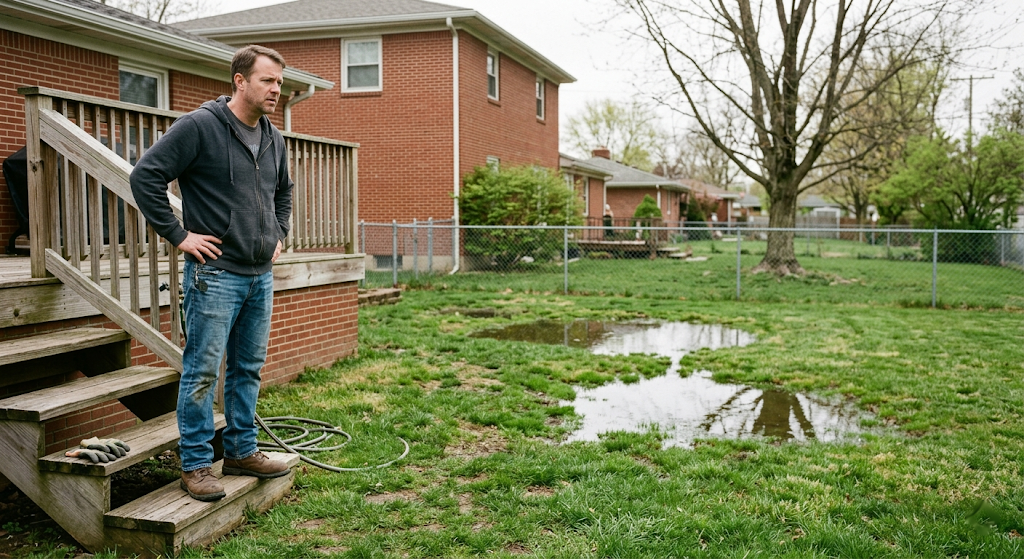
Marcus Webb thought he was being smart. When he bought his house in Broad Ripple back in 2022 — a solid brick two-story just off the White River floodplain — he noticed the spring melt left a long, shallow puddle along his north foundation wall. "It goes away in a few days," his neighbor told him. "Every yard in this neighborhood does that. It's just spring."
Marcus shrugged it off. Year one, year two — puddle shows up, puddle dries out, life goes on.
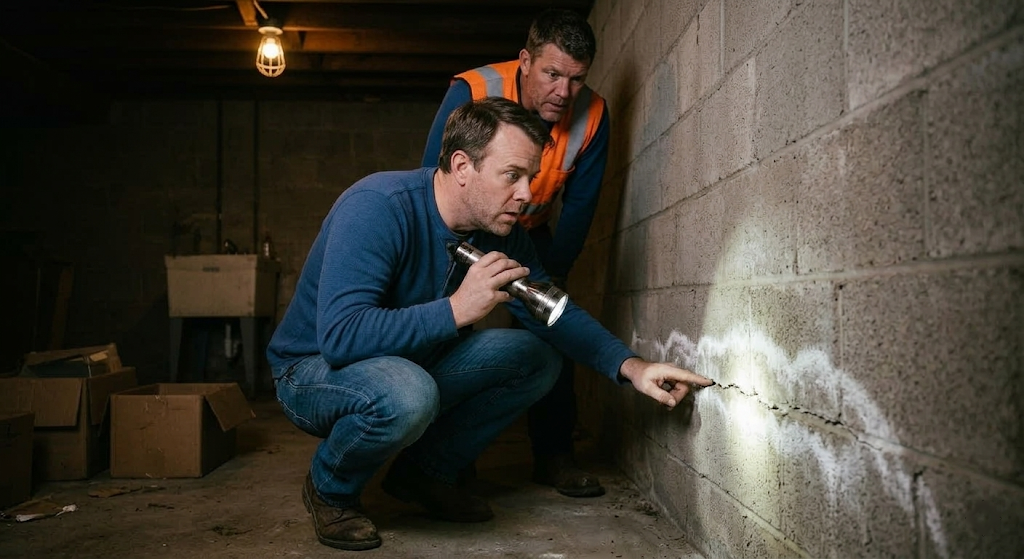
Then last fall, his HVAC tech came downstairs to service the furnace and called up, "Hey man — did you know your basement wall is bowing?"
The repair estimate to stabilize that wall: $14,000. The French drain that would have prevented the whole thing? About $3,200 installed.
Two springs of ignoring standing water next to his foundation. One very expensive lesson.
If you've got standing water in your yard right now — whether it's a soggy low spot out back, a puddle that camps out next to your house for days, or a wet corner of your yard that kills everything you try to plant there — this guide is for you. We're going to break down why it happens, what you actually have, what it costs to fix, and when you need to call a pro before you're looking at a Marcus-sized bill.
Why Midwest Yards Drain So Badly (It's Not Your Fault)

This is what you're fighting: dense, nearly impermeable clay that holds water instead of letting it drain. It's under most Midwest yards. Photo: Pexels
Before you blame yourself, let's talk about why the whole region has this problem.
Indianapolis and Chicago were both flattened by glaciers somewhere around 12,000 to 20,000 years ago. When the ice retreated, it left behind thick deposits of glacial till — a dense, poorly sorted mix of silt, sand, and, most critically, clay. Lots of clay.
In Indianapolis, the two soil series you'll encounter most often in residential yards are the Crosby and Miami series. If you've never heard those names, that's fine — what matters is what they do. The Crosby series is officially classified by the USDA as "somewhat poorly drained." It's a silty clay loam that forms a nearly impermeable layer just below the surface. Water doesn't move through it — it sits on top of it. The Miami series is similar and shows up across the same glacially deposited terrain, in a drainage sequence with Crosby on lower landscape positions — exactly where water accumulates.
In Chicago, it's the same story. The soil across most of the city and its suburbs has a very high clay content, also courtesy of the same glacial deposits. Clay doesn't drain — it swells when wet, holds water, and slowly releases it over days or weeks, not hours.
Then there's Chicago's other problem: most of the city proper is still served by a combined sewer system — one set of pipes that handles both sewage and stormwater. During a heavy rain, that system gets overwhelmed. The Metropolitan Water Reclamation District openly acknowledges that during large storms, the system triggers combined sewer overflows, discharging untreated sewage and stormwater into the Chicago and Calumet river systems. What that means for your yard: even if your own drainage is decent, when the pipes are full, your water has nowhere to go. Neighborhoods like Bridgeport, Back of the Yards, and parts of the South Side feel this acutely.
Add in the fact that most Midwest homes were built on lots graded just barely enough to meet code, with soil that was compacted during construction, and you've got a perfect recipe for standing water.
None of this is your fault. But it is your problem to fix.
Step One: Figure Out What You Actually Have

This is where "it'll dry up" thinking eventually leads. Catch the problem at the yard drainage stage — not this stage. Photo: Pexels
Not all drainage problems are the same, and the fix for a soggy back corner of your yard is completely different from the fix for water pushing against your foundation. Before you spend a dollar, you need to know which one you're dealing with.
Here's the quick diagnostic:
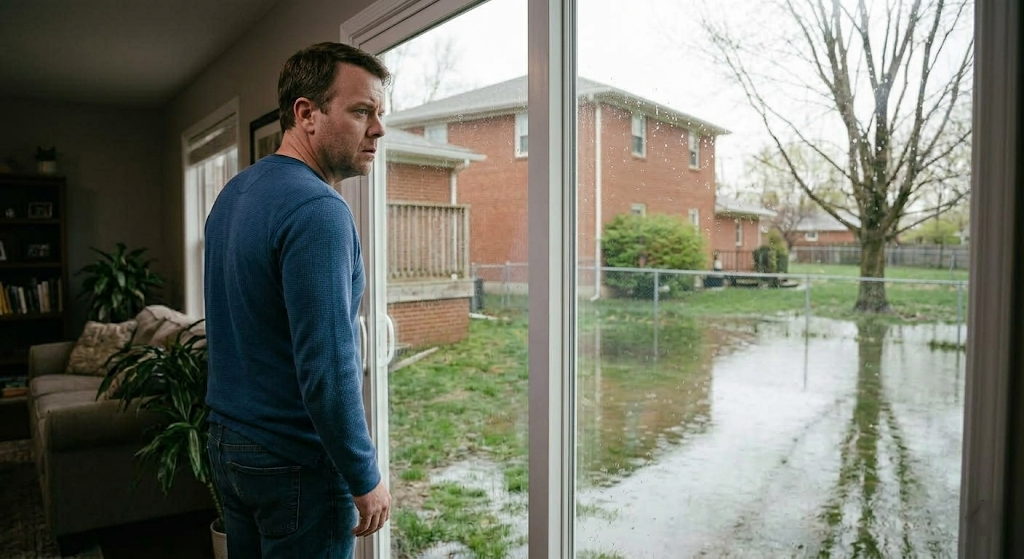
Surface drainage problem — Water pools in your yard after rain but typically dries up within 24 to 48 hours once the rain stops. You've got muddy areas, dead or mossy patches in the wet zone, maybe some landscape plants that keep dying because their roots stay waterlogged. But your basement is dry, and you don't see any cracks, staining, or moisture on your basement walls.
Foundation drainage problem — Water is getting to your foundation wall and building up against it. The signs: water in your basement after a rain event, white chalky deposits (called efflorescence — minerals left behind as water moves through concrete) on your basement walls, cracks in the walls, or — the most serious sign — horizontal cracks or any visible bowing or bulging in the wall itself. If you see bowing, that's structural. Get a foundation specialist on the phone today.
The mechanism that turns a surface problem into a foundation problem is called hydrostatic pressure. When clay soil around your foundation becomes saturated — which it does every spring in Indianapolis and Chicago — it holds that water right against your basement walls. That saturated soil is literally pressing against the concrete with the weight of all that trapped water behind it. Over years, those walls crack. Over more years, they bow inward. What started as a yard drainage issue becomes a structural repair bill in the five figures.
Marcus Webb knows this personally.
The good news: if you catch it at the yard drainage stage, the solutions are much more affordable — and some of them, you can do yourself.
The Solutions, From Cheapest to Most Expensive
Here's the honest rundown of what's available and what it costs. We're going from "grab it off a shelf at Home Depot" to "you need a contractor with a trencher."
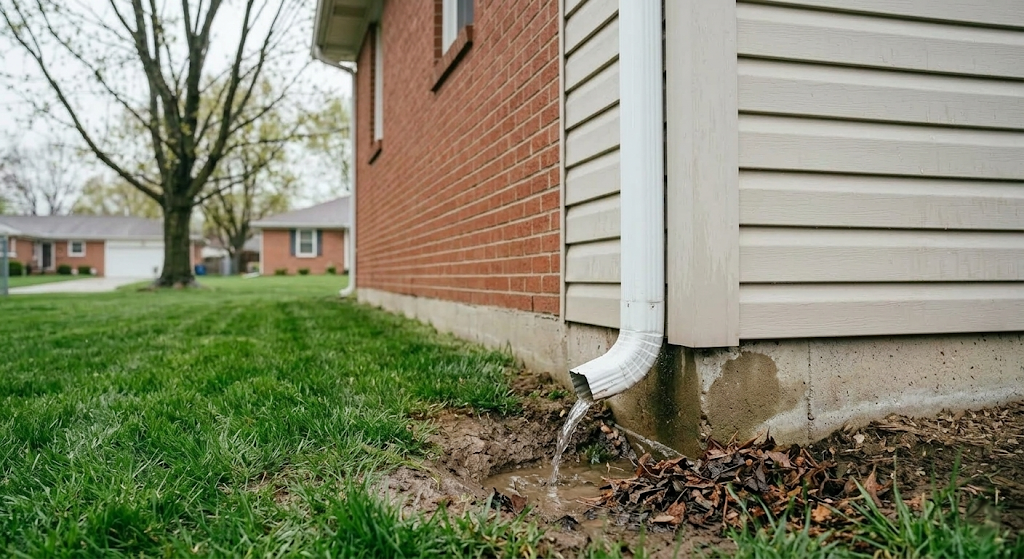
Downspout extensions and buried downspout pipe — $50 to $300 DIY. Your gutters collect a massive amount of water — a 1,500-square-foot roof during a 1-inch rainstorm sheds nearly 1,000 gallons. If that's discharging two feet from your foundation, that's your problem right there. The fix: attach a flexible corrugated pipe to the end of your downspout and run it at least 6 to 10 feet away from the house, or bury it and add a pop-up emitter that opens when water flows and closes when it stops. This is the first thing to try, and many homeowners can do it in an afternoon.
Minor regrading — $200 to $1,500 DIY or pro. If your lawn slopes toward your house, you need to fix the grade. The rule of thumb: the ground should drop at least 6 inches over the first 10 feet away from your foundation. Adding topsoil and regrading a small area is within DIY territory — rent a rake and a tamper, grade away from the house, and reseed. Larger areas with significant slope problems need a contractor with equipment.
Dry creek beds — $500 to $5,000 installed. A decorative rock channel that moves surface water across your yard and looks intentional doing it. Great for swales between properties, areas where you need to move water across the yard without burying a pipe.
Catch basins — $1,000 to $4,000 installed. A surface grate inlet connected to underground pipe that routes to a lower point. Best for a specific low spot in the yard that collects water regardless of what else you do.
Exterior French drain — $2,500 to $10,000+ installed. The heavy hitter for foundation protection and persistent subsurface water problems. More on this below.
Interior French drain / basement waterproofing — $4,000 to $25,000+ installed. Last resort, or the only option if water is already inside. Requires breaking your basement floor.
What a French Drain Actually Is (And Why It Works)
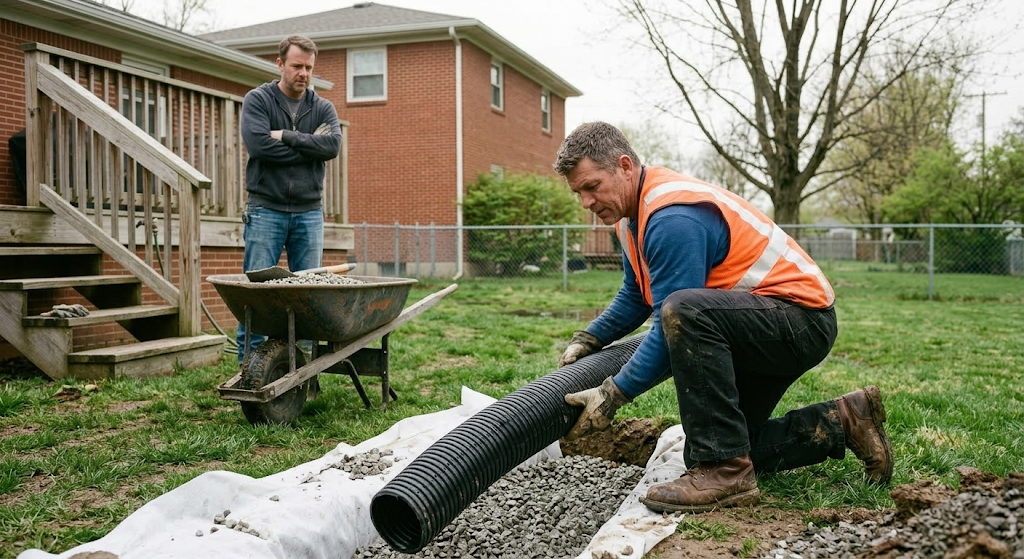
The name sounds fancy and European but the concept is dead simple. A French drain is just a trench filled with gravel and a perforated pipe.
Here's the principle: water follows the path of least resistance. In clay soil, that path is your foundation wall. A French drain creates an easier alternative — a gravel-filled channel where water can flow freely. As groundwater and surface runoff percolate down through the soil, they hit that gravel layer, flow into the perforated pipe, and get carried away to a discharge point — the street, an alley, a storm drain inlet, or a dry well at the back of the property.
The key elements of a well-built French drain: a trench dug to proper depth (typically 18 to 24 inches for a yard drain, deeper for a foundation drain), a layer of washed gravel, a 4-inch perforated PVC or corrugated pipe with a slight downhill slope (minimum 1% grade — 1 inch of drop for every 8 feet of run), filter fabric wrapped around the gravel to keep silt out, and a proper discharge point so water actually has somewhere to go.
Where French drains go wrong: improper slope (water sits in the pipe and clogs), no filter fabric (pipe fills with silt and clay in a few years), bad discharge location (water just ends up in a neighbor's yard or against a different wall), and shallow installation that only catches surface water when the real problem is deeper.
This is why the job-site French drains that homeowners DIY often fail within five years. Getting the slope right, wrapping correctly, and connecting to a real discharge point takes experience. Not impossible to DIY, but requires research and care.
What It's Going to Cost You
Let's talk real numbers. These are 2025-2026 figures for the Indianapolis and Chicago metro areas.
Exterior French drain (yard drainage): In Indianapolis, contractors typically charge $25 to $35 per linear foot installed, including pipe, gravel, filter fabric, and labor. A typical 100-foot exterior French drain around the back half of a lot comes out to $2,500 to $3,500. Add $100 to $300 for any required permits. If your soil is particularly dense clay — which it probably is — expect labor costs to run toward the higher end, as digging through saturated Crosby clay is slow going. In Chicago, where labor costs run higher, budget $30 to $50 per linear foot, or $3,000 to $5,000 for that same 100-foot run.
Interior French drain (basement waterproofing): The calculus changes completely. Contractors have to break up your concrete basement floor, dig a perimeter trench, install the drainage system, add a sump pump, and re-pour the concrete. Expect $40 to $100 per linear foot. A typical basement perimeter system runs $4,000 to $10,000 for a smaller home, and can hit $20,000 to $25,000 for a larger home or severe water intrusion. Sump pump installation adds $500 to $1,200.
Regrading: Small areas (under 500 square feet) can cost $500 to $1,500. Large-scale regrading involving a skid steer and significant soil import: $3,000 to $8,000+.
The full picture: Most homeowners dealing with a persistent drainage problem near their foundation end up with a combination — downspout extensions, regrading, and a French drain together. A realistic all-in budget for a comprehensive exterior drainage fix on a typical Indianapolis or Chicago lot: $4,000 to $8,000.
That's real money, but compare it to Marcus Webb's $14,000 foundation wall repair.
DIY or Hire a Pro? Here's How to Decide
This is where you've got to be honest with yourself. Some of this is legit DIY territory. Some of it is absolutely not.
Do it yourself:
- Downspout extensions and pop-up emitters. Straightforward, no excavation required, available at any hardware store.
- Running buried corrugated drain pipe from a downspout to a discharge point at the edge of your property (as long as it's not near the foundation and the trench is shallow — under 12 inches). But before you pick up a shovel: call 811 first. Always. It's free, it takes three business days, and it marks every buried utility on your property — gas lines, electrical, water, sewer. You don't want to find the gas line with a spade.
- Minor regrading of small areas — adding topsoil and re-sloping away from the house.
- Dry creek bed installation in an area away from the foundation.
Hire a professional:
- Any French drain within 10 feet of your foundation. The slope and connections need to be right the first time. Getting it wrong means you've just paid someone to make your problem worse.
- Any project that requires trenching more than 12 to 18 inches deep.
- Any drainage work that affects how water flows across property lines — potential liability for flooding a neighbor.
- Catch basin installation with underground pipe connections.
- Anything involving the combined sewer system connection in Chicago.
- Interior basement waterproofing — always a professional job.
- Any project in Indianapolis or Chicago requiring a permit.
When you get quotes, ask specifically: "What's the discharge point, and where does the water actually go?" If a contractor can't answer that clearly, find another contractor.
When to Call Before It's Too Late

This is what a drainage fix actually looks like. Professional-grade excavation, proper depth, and the right slope — this is not a weekend YouTube project when your foundation is involved. Photo: Pexels
Here's the thing about foundation drainage problems: they are slow. Slow enough that you convince yourself every spring that it'll be fine. That it'll dry up. That it's normal. And it does dry up — until the year it doesn't, or until the hydrostatic pressure has been working on that basement wall long enough that it starts to move.
Call a drainage contractor now — this week — if:
- You've had standing water against your foundation wall for more than 48 hours after a rain event, two or more seasons in a row.
- You see any horizontal cracks in your basement walls (horizontal cracks are caused by lateral pressure — this is serious).
- You see efflorescence — white chalky deposits — on your basement walls.
- Any visible bowing or movement in the basement wall.
- Water is actually getting inside the basement.
- Your yard has a low spot that stays wet for a week or more after rain stops.
Spring is the most important time to act. The ground is thawing, the clay is saturated, and the pressure is at its peak. It's also when the good contractors are booking up fast. In Indianapolis and Chicago, most drainage contractors are scheduling spring work weeks in advance, and once the ground dries out in June, you'll wait until fall or next spring.
The homeowners who call in March get the appointment. The ones who wait until July get the waitlist — and another season of damage they'll pay for later.
Find a Pro Before the Good Ones Are Booked
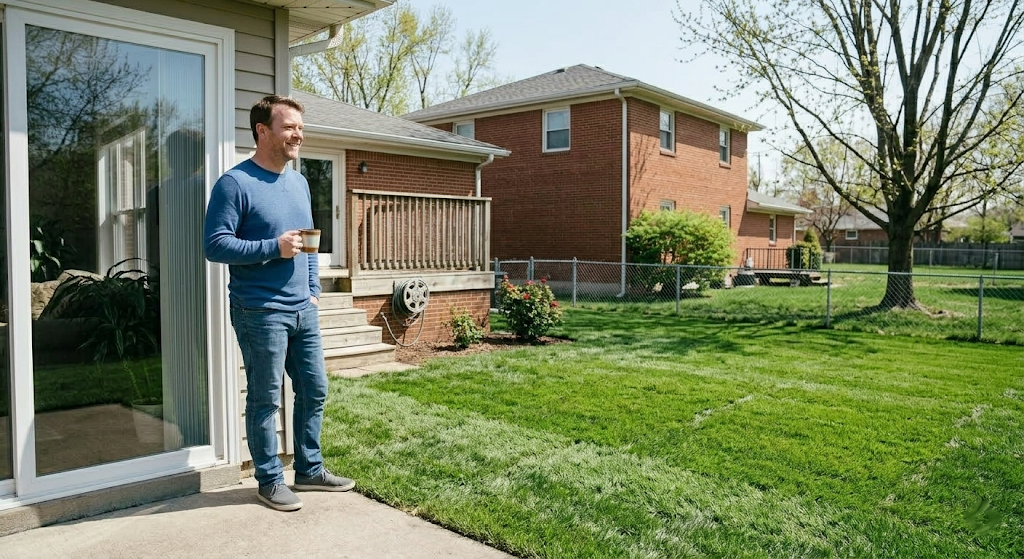
Standing water is your yard's way of telling you something is wrong with how water moves through and around your property. It might be a $200 downspout extension fix. It might be a $4,000 French drain. It might be time to have a serious conversation with a foundation specialist.
The only way to know is to get eyes on it from someone who does this work for a living.
Find a vetted drainage contractor on Saorr — most Indianapolis and Chicago pros are booking spring drainage jobs now before the ground dries out. Don't wait until the standing water turns into a structural repair bill.
Find Trusted Pros Near You
Ready to start your project? Connect with vetted, top-rated contractors in your area.
Get Started